
Anxiety sets in when you enter your tiny greenhouse and notice something is off but aren’t able to identify it right away. There is a slight discoloration on the lower leaves. There is a small curl at the tip of something that was fine two days ago. The previous week, the tomato plant lacked a white dusting. As a result, most gardeners react to these situations by speculating, making incorrect guesses, applying the wrong remedy, and exacerbating the situation. Consider the leaf; it’s a slower, more methodical approach. Check it out. You can learn nearly everything from a leaf if you know how to read it.
Greenhouses are designed to create environments that are highly efficient. In addition to hastening growth, humidity and warmth also cause problems. It can take weeks for a fungus to spread outdoors, but it can colonize an entire tray in just a few days when the air is still and damp. A little wind or rain can naturally suppress pest populations behind glass. It is for this reason that leaf symptoms in a small greenhouse are usually more severe than those in an outdoor garden.
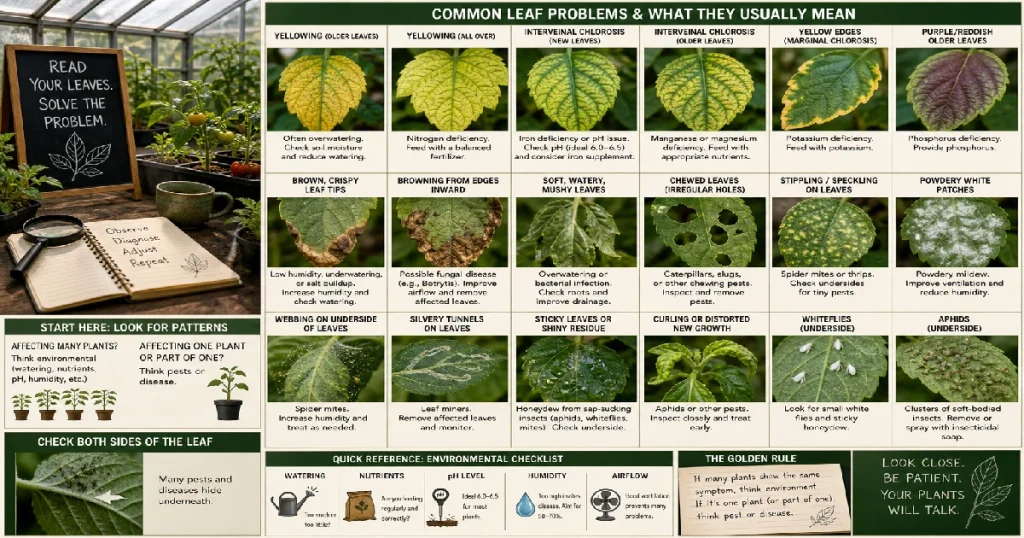
Yellowing is the most confusing symptom, partly because there are so many potential causes and partly because gardeners often assume the worst before considering the obvious. The most common mistake made in greenhouse environments is overwatering, where the impulse to tend and water can outpace what plants actually need. Yellowing of older, lower leaves is often a sign of this. This symptom may also indicate nitrogen deficiency, which is characterized by a general lack of vigor, a washed-out appearance rather than isolated yellowing of lower leaves. One solution requires less water, while the other needs feeding. That difference is important because the solutions require completely different approaches.
In contrast to interveinal chlorosis, which occurs between veins rather than throughout the leaf surface, interveinal chlorosis is a completely different symptom. In most cases, this pattern indicates an iron, manganese, or magnesium deficiency, which can sometimes be caused by a pH issue that prevents the plant from absorbing nutrients from the soil rather than a lack of nutrients. Typically, manganese and magnesium deficiencies appear in older leaves, while iron deficiencies usually appear in the youngest leaves. It’s a subtle difference, but in a small greenhouse with dozens of plants in containers with limited nutrients, it’s important to understand. Yellowing at the leaf margins indicates potassium deficiency, and purple or reddish coloring in older leaves suggests phosphorus deficiency.
Another type of signal is crunchy, dry, and brown leaf tips. Usually, brown tips indicate insufficient water, low humidity, or salt buildup in the soil over time, while yellowing indicates excess water or nutrient deficiencies. Fungal diseases, such as Botrytis, which grow in moist, poorly ventilated environments and spread rapidly in enclosed greenhouse spaces, can be identified by browning and blackening leaves from the edges inward. Likewise, soft, watery, mushy leaves indicate a bacterial infection or overwatering that results in root rot, which often grows underground for a longer period of time than you’d expect.
Physical damage and distortion require a different approach. Slugs or caterpillars can enter a tiny greenhouse through seemingly tiny openings in leaves or edges that appear chewed in erratic patterns. The tiny, pale or silver stippling on leaf surfaces caused by spider mites or thrips is often mistaken for dust damage. When you are aware of the symptoms, these pests are easy to detect. On the underside of leaves, fine webbing confirms the presence of spider mites. One of the most identifiable greenhouse issues is powdery mildew, which is characterized by white, powdery patches on the upper leaf surface. Powdery mildew spreads rapidly if ventilation is inadequate. Under the leaf surface, you can see winding, pale, silvery tunnels made by leaf miners. There is practically a signature to their damage pattern.
| Symptom | Where on plant | Likely cause | Category | Action |
| General yellowing, washed-out look | Older, lower leaves | Overwatering | Watering | Reduce watering frequency |
| Yellowing with lack of vigor | Whole plant | Nitrogen deficiency | Nutrient | Feed with nitrogen-rich fertilizer |
| Yellowing between veins (interveinal chlorosis) | Youngest leaves | Iron deficiency (or pH lockout) | Nutrient | Check and adjust soil pH |
| Yellowing between veins (interveinal chlorosis) | Older leaves | Manganese or magnesium deficiency | Nutrient | Supplement with Mg or Mn; check pH |
| Yellowing at leaf margins | Any | Potassium deficiency | Nutrient | Feed with potassium-rich fertilizer |
| Purple or reddish coloring | Older leaves | Phosphorus deficiency | Nutrient | Feed with phosphorus-rich fertilizer |
| Crunchy, dry brown tips | Leaf tips | Low humidity, underwatering, or salt buildup | Watering | Increase humidity/watering; flush soil salts |
| Browning/blackening from edges inward | Any | Botrytis (fungal disease) | Disease | Improve ventilation; remove affected leaves |
| Soft, watery, mushy leaves | Any | Bacterial infection or root rot from overwatering | Disease | Reduce watering; check roots; improve drainage |
| Irregular holes or chewed edges | Leaf surface or edges | Slugs or caterpillars | Pest | Inspect at night; use slug traps or barriers |
| Pale or silver stippling | Leaf surface | Spider mites or thrips | Pest | Check leaf undersides for webbing; treat with insecticidal soap |
| Fine webbing on underside | Leaf underside | Spider mites | Pest | Treat with miticide or insecticidal soap |
| White powdery patches | Upper leaf surface | Powdery mildew | Disease | Improve ventilation; apply fungicide |
| Winding pale/silvery tunnels | Inside leaf | Leaf miners | Pest | Remove affected leaves; use sticky traps |
| Sticky residue + sooty black mold | Leaf underside | Aphids, whiteflies, or spider mites (honeydew) | Pest | Inspect undersides; treat with insecticidal soap |
| Curling or distortion at growing tips | New growth | Aphids | Pest | Check for aphid colonies; treat promptly |
The underside of leaves should receive special attention, but it rarely does. A shiny, sticky residue on the leaf surfaces beneath the insects’ feeding areas is the first sign of an infestation, which includes aphids, whiteflies, and spider mites. Honeydew is excreted by sap-sucking insects and can eventually harbor a black sooty mold that further weakens the plant. If leaves are curling inward or distorting at the growing tips, aphids are a strong possibility since some species cause specific curling damage.
You should keep one principle in mind when interpreting what you see, based on greenhouse diagnostics guidelines from Michigan State University: If the symptom occurs consistently across a large number of plants at the same time, the cause is most likely environmental—a pH imbalance, a fertilizer problem, a watering pattern, or something else. If the issue is isolated to one plant or a portion of one plant, a pest or localized disease is more likely to be the culprit. In spite of the fact that pattern recognition doesn’t provide the solution right away, it significantly reduces the field. A leisurely, cautious stroll through the greenhouse – actually stopping, flipping leaves and inspecting sticky traps – often reveals something that would have gone unnoticed for another week. Patience is the key to plant communication. Leaves have been conveying the message for some time. The question is whether you’re reading them.
Alyssa Bennet is a Senior Editor at Mini Greenhouse Kits and a passionate advocate for urban gardening and small-space growing. Currently pursuing her major in Arts at the University of California, Alyssa brings a distinctly creative eye to the world of city gardening – blending artistic sensibility with a genuine love for green living. She writes regularly at minigreenhousekits.com, and when she’s not crafting her next gardening piece, you’ll find her with a paintbrush in hand, watching sports, or exploring the city with friends.