
A handful of fresh spinach out of a cold frame in February, when the sky is the color of old pewter and the ground outside is frozen solid, brings a certain quiet satisfaction. I think it’s the kind of moment that makes you pause for a moment because it shouldn’t be possible rather than because it’s dramatic. Growing seasons don’t have to end when the calendar says they should, but for gardeners who have figured it out, they do, consistently and consistently.
Eliot Coleman did more than anyone else to make the concept of a four-season garden attainable for regular home gardeners by making it yield edible food throughout the year. In serious growing circles, the idea has been around for decades. While working out of Nine Springs Farm on the Maine coast in conditions most gardeners would describe as unsuitable for winter production, Coleman developed a system based on cold-hardy crops and inexpensive season extension structures. Four-Season Harvest and The Winter Harvest Handbook became nearly foundational texts for a generation of farmers weary of seeing their gardens go dormant in October. Light, not temperature, is typically the limiting factor in winter gardening. As a result, what is feasible changes significantly.
The difference between warm-season and cool-season crops is crucial for year-round food production. Despite its simplicity, this distinction has significant practical implications. Cucumbers, melons, tomatoes, and peppers are warm-season plants. Frost harms them, and trying to grow them through a northern winter is costly and mostly pointless. The situation is completely different with cool-season crops. Among the plants that can withstand cold are kale, spinach, mache, claytonia, tatsoi, carrots, leeks, radicchio, and parsnips, but some of them even thrive after a frost, where their starches turn into sugars, which makes carrots picked in November that are under straw taste much sweeter than carrots picked in August. Working with the season is much easier than working against it.
It may seem intimidating to plan a four-season garden because it requires thinking in overlapping cycles rather than a single linear season for those who are used to spring-to-fall gardening. During the summer, many growers are unprepared for the crucial plantings for winter consumption. In June and July, you should plant crops that will sustain you through December and January, such as kale, carrots, beets, leeks, broccoli, cabbage, and spinach. By October, when the outdoor garden comes to an end, those crops should be well established, with deep roots and hardened off foliage. It is most common for a four-season garden to fail in its first year if the summer planting window is missed.
Succession planting is another technique that distinguishes a garden that produces continuously from one that produces intermittently. You sow lettuce in small quantities every seven to ten days, stagger the maturity dates so there’s always something ready to pick, rather than planting an entire row at once and harvesting it all in two weeks. The same reasoning applies to turnips, bunching onions, spinach, and radishes. No matter what month it is, there is almost always something fresh from the garden in the kitchen. Making small, regular sowings instead of large seasonal ones does require changing habits, such as planning ahead.
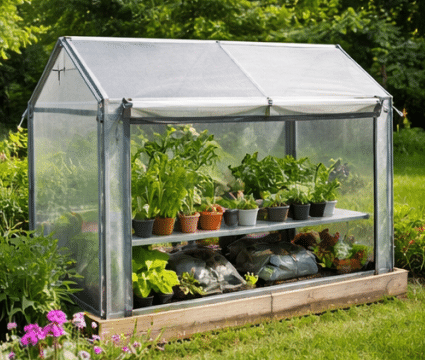
With season extension tools, the four-season garden becomes a practical reality. In addition to extending the growing window by four to six weeks at either end of the season, cold frames—basically bottomless boxes with transparent lids placed directly over garden beds—allow cold-hardy crops to grow during temperatures that would otherwise kill them. Cloches serve a similar purpose on a smaller, more portable scale. An entire raised bed can be shielded with low tunnels made of flexible pipe bent into hoops and covered with frost cloth or clear plastic with just a few hours’ labor. It’s not a high-tech fix. Two centuries ago, French market gardeners used these principles to provide Paris with fresh vegetables throughout the winter: protect against the worst of the cold while allowing enough light to keep growth slow.
Greenhouses and hoophouses greatly enhance crop protection by creating an environment in which crops can not only survive, but also grow. Coleman’s movable hoophouse, a poly-covered structure that slides between a “spring position” and a “fall position,” is a more advanced version of this concept. However, the basic idea is the same for any greenhouse setup: you’re not trying to duplicate summer, just moderate the extremes so cold-tolerant crops can keep doing what they do. Gardeners who produce in December have a small unheated greenhouse in Zone 5, which can effectively change their growing conditions to something closer to Zone 7. Low heat and grow lights make it possible to grow tender herbs and greens that wouldn’t otherwise survive.
Year-round food production often overlooks the storage aspect because it feels more like logistics than gardening. A cold room, root cellar, or even a cool corner of an unheated basement can also be considered part of the four-season system. Harvested at peak maturity and stored properly, potatoes, onions, garlic, carrots, parsnips, rutabagas, and winter squash can sustain a household well into the new year. A successful harvest depends on timing, delaying it as long as possible without allowing crops to reach their peak in the ground, and providing each crop with the ideal storage conditions. Cool, dry conditions are ideal for onions. A cool, slightly humid environment is best for carrots. A cool, dark, and well-ventilated environment is ideal for potatoes. Preparation is key to getting these right, but it’s not difficult.
It is soil health that determines whether the system functions as a whole or gradually deteriorates. A garden that produces food for a full year puts more consistent demands on its soil, requiring more intentional replenishment than a garden that rests half the year. The techniques that keep a year-round garden truly productive rather than slowly deteriorating include adding well-rotted compost or manure in the fall before winter crops are planted, rotating crops systematically to break pest and disease cycles, and minimizing soil disturbance between plantings to minimize soil disturbance. Minimal tillage should be taken seriously because healthy soil has a structure developed over time by networks of fungi and earthworms, and repeatedly turning it causes more harm than good.
Seeing a well-planned four-season garden through the calendar gives me the impression that most people are discouraged from trying it since they think it’s difficult. In the first year, planning is unfamiliar. All of these practices are technically simple, but they contradict customs based on a seasonal rhythm that ends with the first frost. A garden takes on a new identity when its rhythm changes. Instead of a project with a start and end, this is a relationship with a piece of land that produces food every month.