

When you walk into a school greenhouse on a Wednesday morning, the first thing you notice is the noise, not the hum of ventilation fans. There is a debate among children about whether phosphorus should be added to tomato plants. In an old notebook, a girl draws leaf structures. With rulers, two boys who rarely stay together measure water runoff. There doesn’t seem to be a class. There seems to be a genuine thought behind it.
In writing, it is difficult to describe this aspect of school greenhouses. Something happens when a twelve-year-old sows a seed and waits for it to sprout. Plants require nutrients, water, and light, according to the biology textbook. Those mistakes are illustrated in the greenhouse version. It’s not the same as knowing.
Many years ago, technology dominated discussions about enhancing schools–more tablets, better software, faster WiFi. Perhaps those things are important. A systematic study published in PubMed in 2023 found that school gardening programs are associated with better academic outcomes, reduced stress, and healthier eating. It is not because gardens are magical that they are relentlessly real. It is impossible to fake plant growth. It is not possible to copy and paste a harvest.
The covert nature of this movement makes it intriguing.
Some schools are located in wealthy suburbs, while others are in areas where fresh produce is rarely found in grocery stores, let alone cafeterias. In underprivileged communities, gardening initiatives may actually change children’s eating habits, according to a Texas study. Meaning that endures. There seemed to be more to it than just a project for school week; it seemed to follow children home as well.

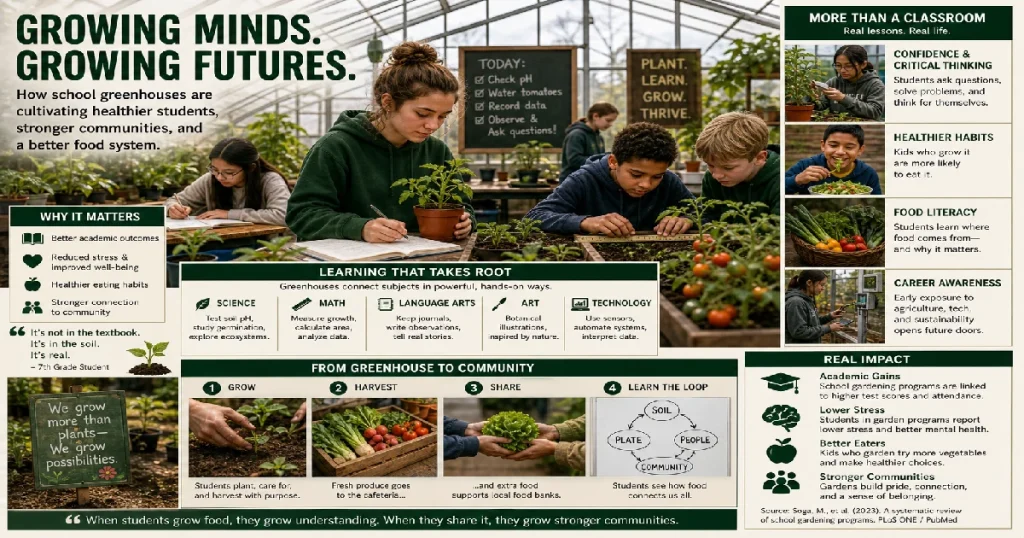
There is a strong academic case for greenhouses that is unknown to most people. When students calculate the water-use efficiency of various irrigation methods, geometry becomes less abstract. Science classes can measure soil pH levels, compare germination rates under various light spectrums, and discuss the results. Art students have been known to exhibit botanical illustrations in school hallways. These structures naturally connect subjects in ways that a typical curriculum almost never does.
When it comes to food sustainability, it becomes truly complex, but in a good way. Some schools are now supplying their own cafeterias with greenhouse produce. Extra food is donated to nearby food banks. In an ambiguous educational sense, pupils are learning more than just food origins. Their community cultivates, distributes, and consumes it. That loop, which goes from soil to plate to neighbor, cannot be replicated in a classroom. In addition, it poses questions that pupils are not used to: What happens during a drought? If the yield decreases, what happens? What criteria are used to determine who receives the additional food?
There is also a career aspect that is sometimes overlooked. The fields of food systems management, environmental science, and agriculture are not specialized. It’s a growing one. Even so, most students graduate without ever having any contact with them. A school greenhouse motivates a fourteen-year-old to consider agricultural engineering as a career path. Since some schools have integrated automated climate controls and soil sensors into their greenhouse setups, students are interacting with data systems similar to those used by professionals. Exposure like that is not insignificant.
The fact remains that not all school greenhouses are successful. Some programs lose appeal when the instructor who was passionate about them leaves. There are some buildings that are underutilized. Maintenance costs and funding are always unanticipated by administrators. There is a sense that the infrastructure is insufficient on its own; you need teachers who find this interesting and who can guide students through a failed crop without making it seem like a failure. It is not a horticultural issue; it is a human issue.
However, it appears that the momentum is genuine. It is hard to quantify the number of students who exhibit different behaviors in schools that have maintained these programs. Perhaps more inquisitive. A less submissive attitude. When taking care of something living, whether it responds to your actions, doesn’t, or surprises you completely, young people’s perceptions of the physical world seem to change. The reason may be a combination of plants, patience, or simply getting your hands dirty. Probably all three.
In the future, school greenhouses will probably use more technology than they do now. Hydroponics, aquaponics, and solar-powered systems are no longer considered fringe technologies. The systems are currently being installed in schools, in areas where food security is not a theoretical concept and the closest farm is hours away. This could be where the most significant portion of the work is taking place – not in districts with adequate funding for sustainability, but in locations where some students are growing their first fresh produce.
This is important to keep in mind. When a child takes a pepper from a plant she watered, watched over, and debated with her classmates before bringing it home, something has happened that was not planned. In the greenhouse, it did. It’s not a minor issue either.
As a Senior Editor at Mini Greenhouse Kits, Hannah Kinsley is a passionate supporter of small-space gardening and urban gardening. Hannah, who is currently majoring in Environmental Policy through the University of Michigan’s Environmental Studies program, infuses her writing with a solid academic foundation and a sincere enthusiasm for the environment. You can find her playing soccer or exploring the city’s green areas with friends when she’s not researching the newest trends in city gardening or creating content for minigreenhousekits.com.