
It can be a little confusing to enter a greenhouse for the first time on a chilly morning. There may be a feeling of brittleness and sharpness in the air outside. There is a subtle smell of damp leaves and soil inside, and it is warmer and softer than outside. There’s nothing fake about it, but it feels controlled. It’s that contrast, not any diagram, that tells the story of greenhouse operation.
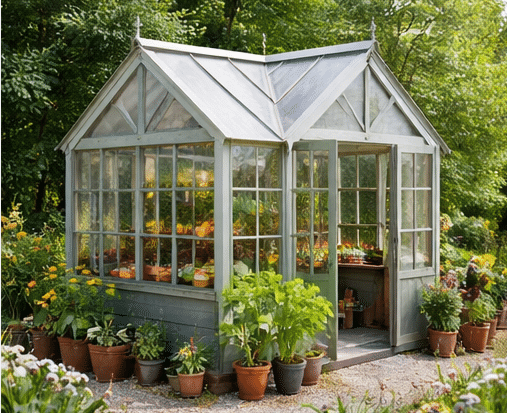
Fundamentally, greenhouses are simple concepts that heavily rely on physics. Light easily penetrates transparent walls made of glass, plastic, and sometimes polycarbonate, warming everything it touches. Light is subtly transformed into heat by moisture-darkened soil, black plant pots, and even the leaves themselves. One could compare it to a parked car in the sun, but in this case, the heat isn’t an annoyance—rather, it’s a benefit.
What follows is what’s interesting. The heat produced inside is difficult to escape. Because it is frequently sealed more tightly than it appears, the structure slows airflow and retains heat. The ground absorbs solar energy during the day and stores it like a battery, releasing it as the temperature drops. Rather than just absorbing sunlight, it seems that the greenhouse extends warmth into the evening when it would otherwise disappear.
Despite this, human intervention is necessary since the concept isn’t perfect. In greenhouses, you will notice subtle changes, such as fans humming, windows cracked open, and shade cloths pulled halfway across the roof. In the absence of them, the area can quickly become too hot, sometimes to the point where plants are stressed or even harmed. Often, it’s unclear how much control is enough in small setups. Cooling is caused by excessive airflow. The room becomes a slow cooker if there isn’t enough.
Light remains the primary motivator. Plants create energy from carbon dioxide, water, and sunlight through photosynthesis. Generally, this process proceeds more effectively in greenhouses due to the steady warmth and prolonged exposure to light. During the darker months, growers sometimes add artificial lighting to extend the day beyond what nature provides. Under gentle LED lighting, rows of seedlings begin to resemble an artificial ecosystem rather than a natural one.
Humidity adds another layer of complexity. The air inside a greenhouse often feels heavy and tropical after watering. Moisture facilitates processes such as transpiration, but it can also cause issues such as mold, mildew, and diseases that thrive in still, damp environments. As growers balance ventilation and moisture while making daily, sometimes hourly, adjustments to their environment, they appear to be walking a tightrope.
Lastly, there is the soil, which is subtly important for everything but is often overlooked. A greenhouse’s soil is more than just dirt; it is tested, managed, and amended. A careful eye is kept on nutrients, compost is added, and textures are modified to retain water without suffocating roots. It is common to see growers crouch down and use their fingers to check the consistency of the soil. It is still possible for the outcomes to be unexpected, but there is a certain level of trust involved in the process.
| Category | Details |
|---|---|
| Topic | How Greenhouses Work |
| Field | Environmental Science / Horticulture |
| Core Principle | The Greenhouse Effect (heat capture and retention) |
| Key Elements | Light, Heat, Humidity, Airflow, Soil |
| Common Materials | Glass, Polycarbonate, Plastic Film |
| Historical Use | Ancient Roman plant protection structures |
| Modern Use | Agriculture, research, home gardening |
| Reference Source | https://www.gi.alaska.edu/alaska-science-forum/how-greenhouse-works |
Location has a greater impact than most people realize. The behavior of a greenhouse in direct sunlight differs from that of one that is shaded by nearby structures or trees. Heat absorption and retention are influenced by several factors, including elevation, wind exposure, and even the structure’s own angle. Some growers align their greenhouses east to west in order to maximize sunlight. In others, releasing heat quickly is more difficult than capturing it.
It’s remarkable how little of it appears static after observing these areas for a while. A greenhouse is more than a building; it’s a system that’s always changing, sometimes in unexpected ways. Taking inspiration from nature, it creates a microclimate that falls somewhere between indoors and outdoors. The balance has a subtle tension that suggests that control is never fully achieved.
That may be the real lesson. Instead of eradicating nature, greenhouses reshape it, capturing sunlight, retaining warmth, and giving plants a better chance than they would have otherwise. Watching it all unfold day by day, it becomes clear that the science is only one aspect of the story. Observation, patience, and an ability to adjust when the system does not work as intended are the remaining elements.