

On a Tuesday morning, you notice how quiet a mid-sized hydroponic facility is. Climate units and pumps fill the air, so it’s not silent, but it’s quiet in a human sense. There is no manual mixing of nutrients or bending over a hose, but a few people move between rows of leafy greens, checking screens and adjusting trays. All the systems that feed, monitor, and manage the plants run whether or not anyone is around. I find it strange and a little confusing. Growing food has always felt like physical labor. That is becoming less and less common.
Due to labor costs, water scarcity concerns, and affordable sensor technology, the trend toward automated growing systems has accelerated significantly in recent years. Home growers and small commercial producers can now take advantage of automated nutrient dosing, climate control loops, and real-time plant health monitoring, which were previously only available to large commercial operations. Despite not completely disappearing, the barrier has significantly decreased.

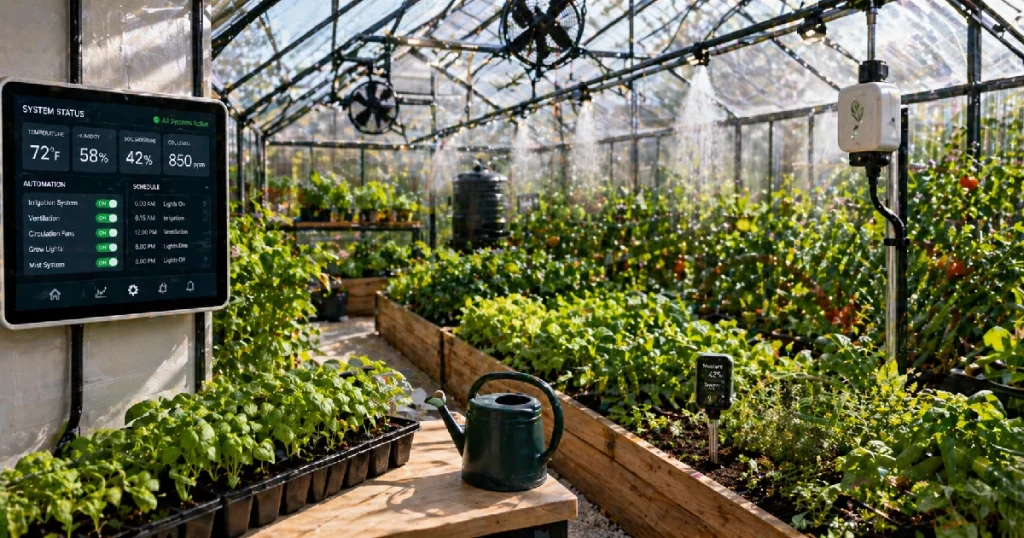
Automating tasks that took a lot of time and yielded little benefit is where automation shines. The process of feeding and watering by hand requires daily attention, meticulous measuring, and a fairly exact schedule that doesn’t work well on weekends or while traveling. Using sensors that measure pH, moisture content, and nutrient concentrations in real time, automated systems replace the entire cycle; delivery is only initiated when thresholds are exceeded. The company Grownetics cites research showing that switching from manual to automated nutrient delivery can significantly improve consistency and reduce labor costs. Although conditions vary greatly, it is still unclear whether these numbers apply to all growing environments. In spite of this, it is difficult to dispute the directional finding.
As this technology permeates both home and commercial growing circles, the concern about overwatering seems to be slowly fading away. The problem of overwatering has always been a human one, resulting from poor timing and well-intentioned motives. Sensors have bad intentions. Either they read the data and take appropriate action, or they don’t. Furthermore, the result is measurably lower water consumption, which is more than incidental considering how many growing regions are subject to water restrictions.
When it comes to climate control, things get really interesting. In spite of seasoned growers’ best efforts, it is difficult to manually control temperature, humidity, CO2 levels, and light cycles throughout the entire growing process. Automatic systems handle these variables concurrently, making tiny adjustments that are impossible for a human to duplicate twice a day. Vertical farming has advanced through the integration of robotics and real-time environmental control into cube-based growing structures that function with a level of precision that seems almost excessive until you see the yield data. Because of the consistency it produces, crop after crop, season after season, automated climate management may eventually convince dubious growers that it’s more than just a convenience.
The home-growing aspect of this story is less dramatic, but it may reveal more about the future. Hobbyists and small-scale indoor growers nowadays use app-connected monitoring, automated feeding schedules, and alert systems that identify problems before they become crop failures. Whenever pH varies from the target range, a grower overseeing a small arrangement of vertical planters will be notified before any damage is done. A similar early warning system would have required expensive professional equipment or ongoing manual testing in the past. A mid-range consumer product nowadays has it as an option.
| Area | What automation does | Limitation | Effectiveness |
| Nutrient dosing | Sensors measure pH, moisture, and nutrient levels in real time; delivery triggers only when thresholds are crossed — no manual mixing or scheduling. | Results vary across growing environments; claimed consistency gains don’t apply universally. | Strong |
| Watering | Eliminates overwatering by responding to actual soil/medium moisture rather than fixed schedules or human intuition. | Sensor failure or miscalibration can go unnoticed without periodic human checks. | Strong |
| Water efficiency | Sensor-driven delivery measurably reduces overall water consumption — relevant in regions with water restrictions. | Savings depend heavily on the baseline; poorly set thresholds can negate gains. | Strong |
| Climate control | Manages temperature, humidity, CO2, and light cycles simultaneously, making micro-adjustments no human could replicate consistently. | High setup complexity; most accessible to larger commercial or vertical farming operations. | Strong |
| Home monitoring | App-connected sensors alert small-scale growers when pH or other variables drift, catching problems before crop damage occurs. | Alert fatigue or app dependency can become issues; connectivity failures leave growers blind. | Partial |
| Problem diagnosis | Sensors reliably detect when something is wrong — out-of-range readings, unexpected drops, stress signals. | Cannot reliably identify the root cause or adapt to novel, unforeseen problems the way an experienced grower can. | Limited |
| Grower judgment | Routine maintenance tasks (hand-watering, feed mixing, reservoir checks) are reduced or eliminated, freeing up time for higher-level decisions. | Intuition built through seasons of hands-on plant care is harder to replace — and may be lost if growers disengage from daily rhythms. | Limited |
The growing automation discourse is hard to ignore. There was previously a great deal of anxiety about whether automated systems could ever replace an experienced grower’s judgment-the intuition developed over seasons of handling plants, interpreting subtle stress signals, and making feel-based adjustments. The argument still hasn’t been settled, and it probably shouldn’t be. The automation of routine maintenance is genuinely effective, but its ability to handle unforeseen situations is less apparent. Sensors can detect problems. Often, it cannot identify the cause or respond to an unknown issue with the same adaptability as an experienced person.
Human involvement is becoming more of a redistribution than a replacement in practice. Routine daily tasks, such as hand-watering individual plants, mixing feeds, and checking reservoirs, are being reduced or eliminated. Less exercise and more thought are required for what’s left. Whether or not someone feels progress will depend on why they began growing in the first place. The contemplative rhythm of daily plant care is taken away by automation. This eliminates a burden for those who are primarily concerned with results. Both responses make sense, and the technology doesn’t really care which camp you’re in. The process simply continues.
As a Senior Editor at Mini Greenhouse Kits, Hannah Kinsley is a passionate supporter of small-space gardening and urban gardening. Hannah, who is currently majoring in Environmental Policy through the University of Michigan’s Environmental Studies program, infuses her writing with a solid academic foundation and a sincere enthusiasm for the environment. You can find her playing soccer or exploring the city’s green areas with friends when she’s not researching the newest trends in city gardening or creating content for minigreenhousekits.com.