
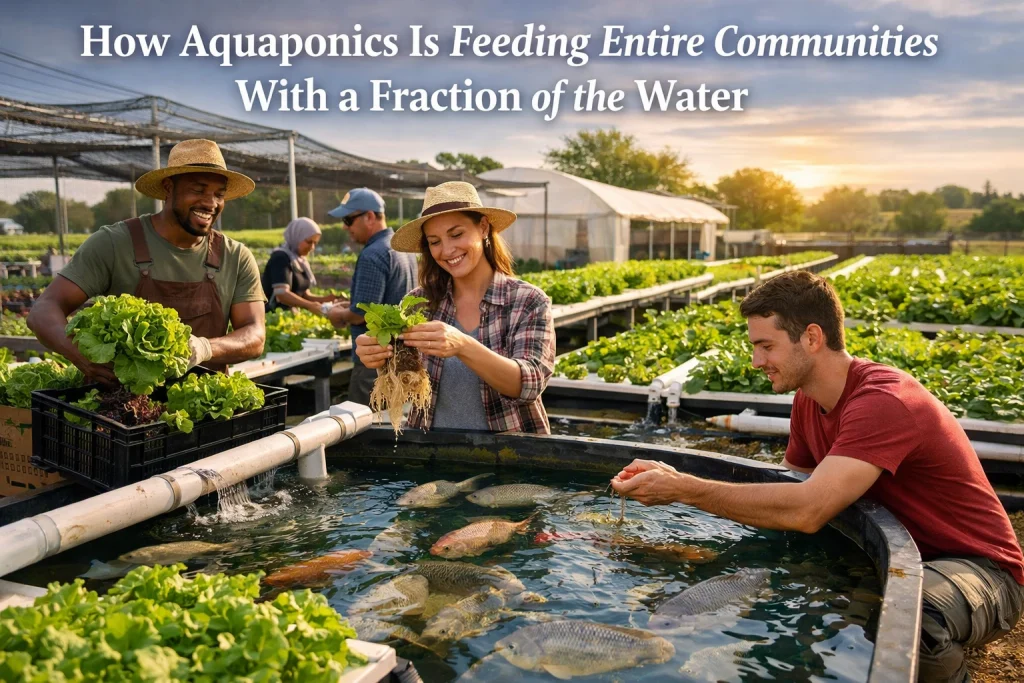
On the roof of a Brooklyn housing complex, something that doesn’t seem to work continues to function. Leafy greens grow in channels fed by water circulating from tanks below, where tilapia swim. Waste is generated by the fish. Bacteria convert that waste into nitrates. Plants absorb nitrates from the water to purify it. Fish get their water back. There is no waste. There is very little added. As a former nutrition counselor from Lagos, Yemi Amu started Oko Farms as a way to feed formerly homeless people who refused to leave their building for groceries.
Amu’s journey to aquaponics is not unusual. A simple search for farming options rarely leads to finding the right system. The solution appears out of nowhere as a solution to a particular problem in a particular location, but it ends up addressing a much wider range of problems than the one for which it was initially intended. An initial rooftop project has evolved into an effective demonstration of how food can be produced in places where soil agriculture is simply not feasible, such as rooftops, abandoned warehouses, flood-prone river deltas, and—increasingly—the kinds of water-scarce areas where conventional agriculture is failing as climate stress and increased demand combine.
As a result of industrial agriculture, centuries of precedent were essentially eliminated. The Aztecs created chinampas, floating farms that extended their growing capacity onto lake surfaces, around the year 1000 AD. Fish waste from the water below fed the crops above. Fishermen in Southeast Asia have raised rice and fish in the same paddies for generations, intuitively understanding what modern aquaponics formalizes with pumps and pH meters: that fish and plants are mutually supportive. During the industrial revolution, crop production and animal husbandry were divided into separate, optimized operations. Aquaponics reunites them, and the efficiency increases are significant and quantifiable.
The water figures initially frighten most people. Over 70% of freshwater used worldwide is consumed by conventional agriculture, and most of that water is lost to evaporation, runoff, and soil absorption. With an aquaponics system recirculating continuously within a closed loop, plant transpiration and evaporation account for only 1% to 2% of the total volume lost daily. Producing the same amount of food requires 90% less water. It is not an environmental preference in areas that already have water restrictions, and the number of these areas is growing. This is an actual calculation of what is feasible.
In aquaponic systems, plant growth occurs 30 to 50% faster than in soil because nutrients are continuously delivered directly to root zones rather than extracted by roots from soil particles in a less reliable process. Through a system that produces tilapia and lettuce simultaneously, two food sources from a single operation, nutritional diversity is provided that neither one could provide alone. An aquaponic kit donated by a group of students feeds over 200 children in Haiti every day through a school lunch program. Refugee camps in Uganda have implemented programs that have significantly reduced child malnutrition while providing families with food and income. In Bangladesh, where seasonal flooding makes conventional agriculture unreliable, floating aquaponic gardens grow crops above rising water instead of drowning beneath it.
There are real challenges that need to be stated clearly. Many communities cannot afford the initial setup costs without outside assistance. The system requires sufficient technical knowledge to maintain fish health, control pH levels, and prevent collapse in the event of a power outage. Consequently, aquaponics projects have failed after the founding organizations left, leaving communities with unmaintainable equipment. Companies like Atlas Aquaponics, Oko Farms, and similar organizations emphasize local capacity building and training more than hardware. In general, systems that are installed and handed over do not survive; systems that are understood and owned by the people operating them do.
The aquaponics thread from Bangladeshi flood plains to Ugandan camps to Brooklyn rooftops makes it difficult to ignore the fact that who controls the technology is nearly as important as the technology itself. Yemi Amu describes her workshop model this way: rather than distributing food, it distributes the knowledge of how to grow it. To her, food sovereignty means empowering people to manage their own food supply rather than being permanently dependent on aid programs. Aquaponics, which is constructed from locally available materials and maintained with locally held knowledge, makes it possible for food to be imported in a way imported food cannot. There is still a question as to whether the strategy can scale to address food insecurity at the level required. Nevertheless, where it is effective, lettuce grows, fish swim, and results are evident.