
A person who purchases a small greenhouse for their backyard is motivated by optimism. As the outside world scorches or shivers, you envision verdant tomatoes in October, herbs in February, and tiny seedlings emerging from the dark soil. You seem to have defeated nature for a moment. Summer arrives, and even though you watered your plants that morning, they look as if someone forgot to water them in a desert one afternoon when you open the greenhouse door.
The packaging does not include this section.
There is something genuinely appealing about a tiny backyard greenhouse. In addition to giving gardeners a sense of control, they prolong the growing season and protect delicate plants from frost damage. However, climate management-the aspect that costs people money, plants, and sometimes the will to live-isn’t discussed. Specifically, the harsh and sometimes unrelenting problem of controlling humidity and heat inside a building that intentionally traps both.
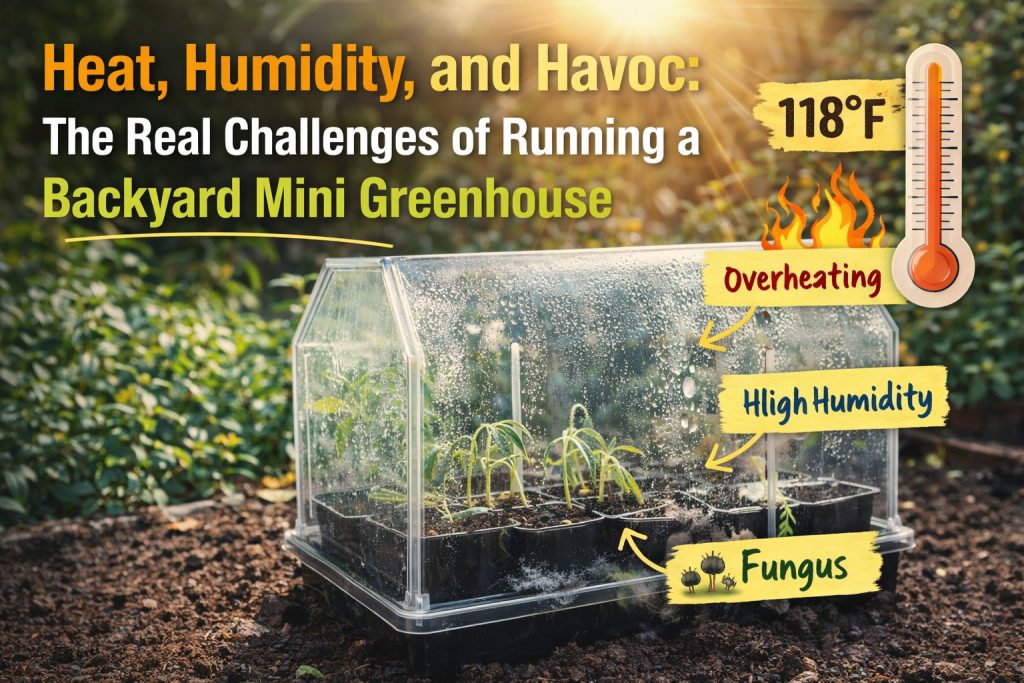
Heat quickly builds up in small greenhouses. The process is faster than most novice growers expect. On a summer afternoon, temperatures inside a mini greenhouse can rise well above 50°C if ventilation is inadequate or the grower is simply preoccupied and forgets to open the vents. This is not a fringe issue. It’s a known, persistent problem. On hobbyist forums, there are many stories that are nearly identical: a gardener leaves for a few hours, returns, and finds the entire operation gone. Errors are very rare.
Due to its relationship with humidity, the heat problem is more difficult to solve than it appears at first. In many ways, new greenhouse owners are unaware of the connection between the two; they do not move independently. As the temperature rises in a closed greenhouse, relative humidity decreases. It may seem trivial when you consider what happens to a cucumber crop at 30°C and 30% relative humidity. A nutrient shortage is evident in the yellowish, stressed, and flagging leaves. Magnesium, however, is not lacking in them. Water is what it is. Alternatively, the roots are unable to transfer water quickly enough to compensate for the rate at which the leaves are losing it to the dry air. In his years of advising small greenhouse operations, agronomist Dr. Mohyuddin Mirza refers to this as “transpiration stress.” This is easy to misdiagnose and treat incorrectly.
The natural reaction to too much heat in a greenhouse is to open the doors and let in fresh air. It works to a certain extent. The summer air that enters the greenhouse is often dry as well; opening the greenhouse lowers the humidity even more, but only slightly decreases the temperature. While resolving one aspect of the problem, you sharpen another. By misting, moistening the floors, and using a tiny fan, some growers try to compensate. It is beneficial to use these methods, but they need to be considered. Consistency is essential. A real person must be present.
Pest and disease pressure often follows climate instability like an unwelcome guest who senses weakness in these structures. In hot, dry environments, whiteflies and spider mites thrive, and eggplants seem to be particularly attractive to them. A different problem arises when humidity swings in the opposite direction and rises too high. Botrytis grey mold grows wherever temperatures drop to the dew point at night, and adventitious roots grow on tomato stems as a result of an unbalanced internal ecosystem. Fusarium and powdery mildew exhibit similar opportunistic patterns. It is likely that many greenhouse growers who lose crops to these pathogens are unaware that the opening was originally caused by climatic changes.
Answers are available. Regardless of whether it’s a traditional application of hydrated lime or flour slurry used in earlier commercial operations, shade cloth on the roof reduces incoming light and heat. Approximately 5% of the light that enters a greenhouse is used for photosynthesis; the remainder is converted to heat. When you know that ratio, you have a different perspective on how to cover the glass. Fogging systems are in place. If you are unwilling or unable to purchase complete climate control equipment, even a basic fan that circulates cool, humid air throughout the building during the hottest part of the afternoon can make a huge difference. Interventions of this type are not complicated. It is simply a matter of being aware of them before the issue arises.
In reality, backyard mini greenhouses require more maintenance than most people realize. Passive structures don’t compensate, self-regulate, or sound an alarm when something goes wrong. It is impossible to grow several crops in a small space because beans have completely different preferences from basil, and peppers require different conditions from cucumbers. Trying to satisfy them all with a single irrigation line and thermostat setting is at best a compromise; at worst, it’s a long process of watching each crop fall just short.
Backyard greenhouses are still valuable despite all of this. Many gardeners achieve remarkable results by paying close attention to details and learning from their mistakes. Vendors, gardening publications, and the general enthusiasm for gardening routinely understate the challenge. Rather than sporadic setbacks, the heat, humidity, quick pest cycles, and limited intervention windows represent actual aspects of the experience. The most helpful thing someone who is new to greenhouse growing can learn is to be honest about it from the beginning.