
Upon entering one of the more recent vertical farms in Singapore or Bristol, you immediately notice the quiet. There are no tractors outside, no irrigation channels running, and no soil being turned. Just a closed chamber with rows of plants suspended above, roots hanging freely inside, and nozzles no wider than pencil tips delivering a barely audible mist at precisely timed intervals. It looks like the set of a low-budget science fiction film. However, the plants are growing at a rate that would be difficult to maintain outdoors.
Plant roots are suspended in a closed, humid chamber and fed with nutrient solution instead of soil or standing water in aeroponics. Aeroponics derives from the Greek words aer, meaning air, and ponos, meaning labor. During the 1990s, NASA researchers developed the idea to see if food could be grown on spacecraft without transporting large amounts of soil or water. Since then, the findings from that research context have gradually filtered into commercial agriculture. Due to shifts in energy costs, water scarcity, and urban food production logic, they have accelerated significantly over the last ten years.
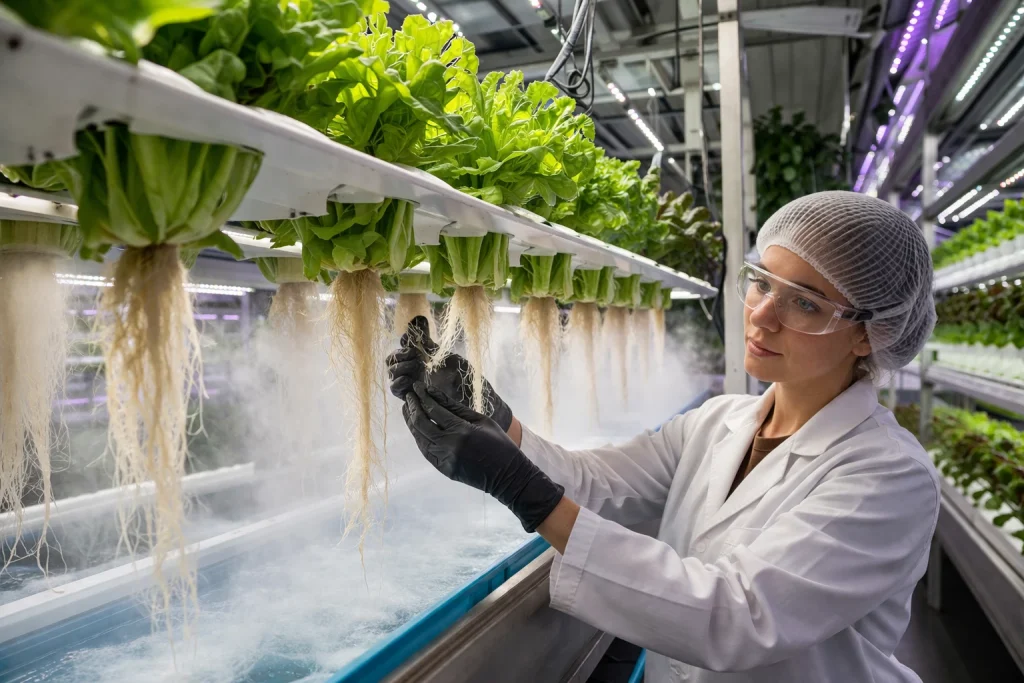
Science revolves around oxygen. Soil limits root oxygen availability to less than five parts per million, which limits plant growth and nutrient absorption by roots. A plant suspended in air has access to atmospheric oxygen at a rate of about 21%, which is a completely different environment than what plant physiologists refer to as hypoxia. Nutrient mist, delivered by high-pressure pumps at droplets of about 50 microns, can be directly absorbed by root hair cells without competition, variability, or disease risk that soil poses. A variety of crops consistently experience three times faster growth rates and yield increases of 45 to 75% than their soil-grown counterparts. These figures may seem unbelievable at first, but they have been replicated frequently enough to be taken seriously.
Water use is the strongest environmental argument for aeroponic farming. Conventional agriculture consumes approximately 70% of freshwater worldwide. A closed-loop aeroponic system uses 95–98% less water than soil-based growing because it continuously recycles its nutrient mist. In areas facing water restrictions, growing abstraction costs, or erratic summer rainfall that has become common in much of Europe, that distinction goes beyond environmental preferences to simple economics. In the same way, a soil-free growing environment reduces chemical inputs for many crops to almost zero by eliminating the conditions that most soil-borne diseases and pests establish.
There is a rapid development of technology that is not well known by the general public. As an alternative to mechanical nozzles that require maintenance and are prone to clogging, ultrasonic aeroponics creates mist using high-frequency sound waves instead of mechanical nozzles. The plasma-activated mist technique, which involves ionized water and increases nutrients’ immediate availability to root cells, has shown encouraging results in early trials published in 2025. A number of facilities in the Netherlands and the UK are already using AI-managed misting systems for commercial purposes. In real time, these systems adjust intervals and nutrient concentrations based on sensor data from inside the growing chamber. The Bristol-based business LettUs Grow, which developed ultrasonic aeroponic technology for commercial scale, is one of the more prominent recent examples of the industry attracting significant investment.
Genuine challenges deserve honest naming. The initial costs of establishing an aeroponic facility are higher than those of establishing a traditional greenhouse. The systems are sensitive to power outages and require technical expertise to operate; roots exposed to air without the misting cycle for just a few hours can dry out irreversibly. Because of energy costs, crop value, and market proximity, aeroponic farming is most popular in urban settings growing high-value crops such as herbs, lettuce, and strawberries rather than commodity grains. As water-intensive agriculture costs rise, it remains unclear whether the economics will work at scale for staple crops or if the question will eventually become less relevant.
As you watch the mist cycle start and the roots catch the droplets in a room that has a subtle scent of minerals and green growth, you get the sense that something significant is being discovered. In twenty years, this approach will appear less radical than it does today, similar to hydroponic tomatoes in supermarkets. There is no perfect solution to food production, but it is a significant addition to the options available.