

Every residential street has a house that everyone notices. Not the biggest, not the most expensive, and not always the one with the latest paint job or roof. In this front garden, the planting exudes confidence, the path naturally directs the viewer’s attention toward the door, and the entire arrangement makes you slow down as you walk by. Most people believe that the garden was professionally designed. In many cases, it wasn’t.
There is something odd about front gardens. From fifteen feet away on the pavement, they serve nearly everyone, including neighbors, passersby, and guests who get their first impression of a home. Because of their dual nature-private ownership and public performance-they are both fascinating to design and surprisingly easy to get wrong. The most common failure is not ugly. Apathy is the problem. There is a patch of tired grass, a straggly shrub, and a path leading to the door in the most perfunctory manner. Since most homeowners pass by their front gardens on a daily basis without thinking about them, it’s possible that more front gardens fit this description than they realize.

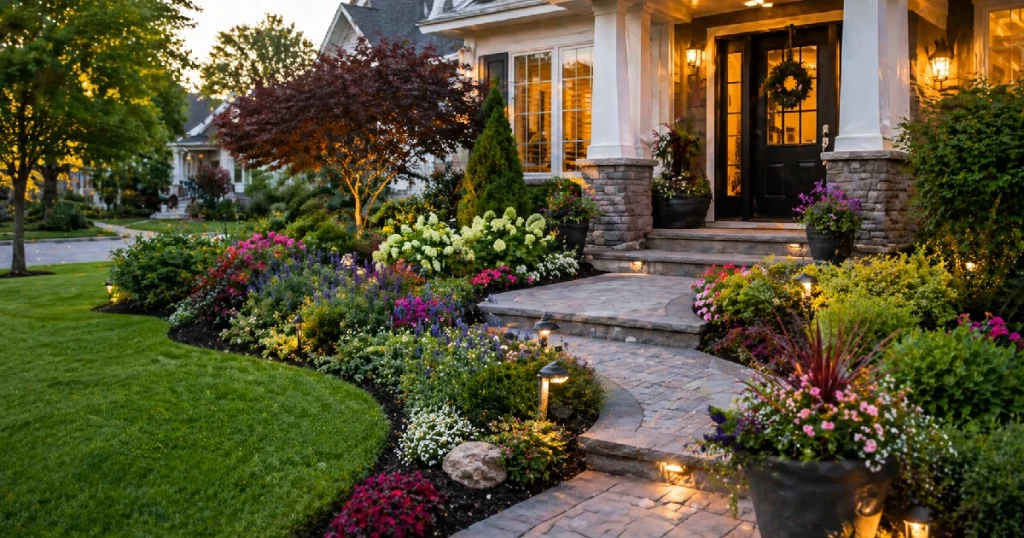
Plants are not the first, or perhaps most crucial, choice. Realizing the purpose of the front garden is important. It is important for some homes to make visitors feel as though they are being embraced from the moment they walk through the door. Instead of a garden that clashes with the architecture, some prefer something quieter and more structured. Low maintenance plants can withstand a dry August without daily maintenance. Make sure you have a clear intention before you spend money on plants. In the long run, you’ll save a lot of money and frustration by doing this. Do-it-yourself gardeners typically ignore this step, which results in poor results.
Once the intention is clear, the path becomes the spine of the design. Straight routes from the gate to the front door are the most common-and often the least interesting. Rather than just providing access, a gently curved alternative-even one that is subtle-creates a sense of arrival. Edging is perhaps more important than most people realize. With a clearly defined border between path and planting, a haphazard scattering of plants is transformed into something that reads as deliberate and thoughtful. Although it’s a minor detail, visitors notice it without being able to explain why the garden appears so well-kept.
Most people give plant selection their full attention, and they should, but there are some restrictions. One of the most reliable components of front gardens are perennials, which grow in size and presence over time and return year after year without human intervention. The front garden planted this spring may appear sparse for a season or two because perennials usually take three to five years to reach their full potential. You can switch up the color scheme every year with annuals, but they are expensive and need to be replanted every year. It is typically the method that produces the most consistently striking results throughout the year, creating a strong perennial backbone with annual color woven in.
Layering distinguishes a planting scheme that appears designed from one that merely appears planted. In general, lower ground cover at the front edge of a bed is graduated down from taller plants toward the back or center. This gives the planting depth and visual movement rather than stopping the eye at a flat wall of vegetation. Dahlias are at their best in August, so consider using evergreen shrubs to stabilize the design through winter, when everything else dies back, when the garden needs to function.
Most residential front gardens neglect lighting, which is why they often appear better in summer daylight than they do at other times of the year. With a few strategically placed pathway lights (low-voltage solar options have become genuinely good in recent years), a front garden looks completely different at dusk and into the evening. They make the difference between a garden that operates twelve hours a day and one that operates twenty-four hours a day by creating atmosphere, making the path safe, and making the path readable.
| Topic | Front Garden Design & Curb Appeal |
| Design Style Range | Cottage, Modern, Native, Traditional, Wildflower, Xeriscape |
| Key Elements | Pathways, plant layering, lighting, focal points, entrance framing |
| Maintenance Level | Low to High depending on plant and design choices |
| Best Plants for Year-Round Interest | Evergreen shrubs, perennials, ornamental grasses, climbing roses |
| Common Mistakes | Overcrowding, wrong plant scale, no focal point, ignoring the path |
| Budget Range | $50 DIY refresh to $5,000+ full professional redesign |
| Ideal Starting Point | Sketch the space, evaluate light, identify the style of your home |
| Reference & Source | www.rhs.org.uk/garden-design/front-garden-ideas |
Entrances, including the door, porch, and threshold, tend to either support or contradict the garden’s goals. It doesn’t matter how beautiful the planting is if the front door is outdated and the wrong color. Alternatively, a door in a bold, well-chosen color, such as a warm red, a deep navy, or a specific shade of sage green, unifies the entire composition and provides a focal point that the planting can complement rather than compete with. You can use containers on either side of the door to implement this concept quickly. With two large, matching pots and a trailing annual spilling over the edges, a bare entrance can be transformed in just one afternoon.
Considering the alternatives – hardstanding over every square foot to create parking – have made entire streets grey and impermeable, it’s difficult to feel optimistic about the shift in front garden culture. More homeowners are rethinking that calculation, choosing permeable paving, adding vegetation to driveways, or completely abandoning car-centric thinking. It’s not so much a trend as it’s a gradual realization that the area between the pavement and the front door is actually important because it influences how neighbors perceive their street, how kids perceive their neighborhood, and how you feel whenever you return home.
Alyssa Bennet is a Senior Editor at Mini Greenhouse Kits and a passionate advocate for urban gardening and small-space growing. Currently pursuing her major in Arts at the University of California, Alyssa brings a distinctly creative eye to the world of city gardening – blending artistic sensibility with a genuine love for green living. She writes regularly at minigreenhousekits.com, and when she’s not crafting her next gardening piece, you’ll find her with a paintbrush in hand, watching sports, or exploring the city with friends.