

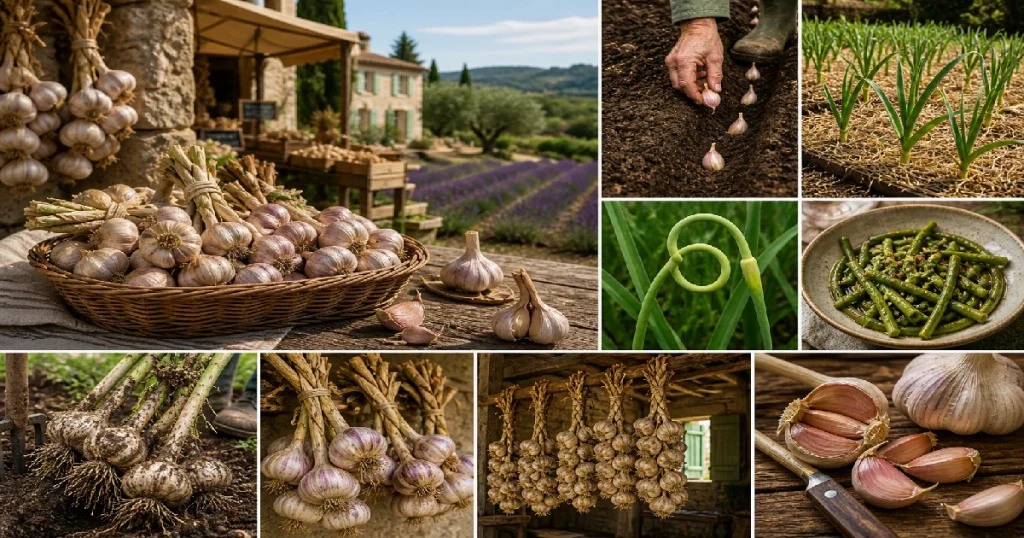
The markets of Provence and the Languedoc in southern France do not consider garlic a seasoning. It is treated like a crop. The dried papery skins catch the morning light as they hang from market stalls and farmhouse rafters, and the pleasant scent permeates everything around them. It appears as frequently on Provençal tables as bread elsewhere: expected, present, and unremarkable. Mousse pouring over veggies on the table at Le Plateau: simply pureed vegetables, roasted for 30 seconds, drizzled with olive oil and topped with a peppery aoli sauce. A plastic net bag is not used to transport garlic from California. The land was planted in the fall, cared for over the winter, and harvested in the summer. Compared to the garlic most Anglophones keep on their counters, that garlic has a noticeable difference in flavor.
Garlic isn’t technically difficult to grow. A willingness to plant something whose reward is nine months away is more important than skill. Due to the delay between planting and harvesting, most people don’t try it more than once. The act of burying individual cloves in chilly autumn soil, covering them, mulching them, and then walking away until spring has a peculiar psychological effect. There is no immediate satisfaction. There was no visible evidence of anything happening for weeks. Garlic, however, works underground in a way that isn’t visible from the surface. As it grows roots through the cooling soil, it gets ready for the cold season, which will make it grow into a full, fat bulb by summer.
Cold weather is not optional. As a result of this particular detail, supermarket garlic, which is often sourced from large commercial operations in mild climates, should never be used as planting stock because it hasn’t been selected for the climate you’re planting it in and may have been treated to prevent sprouting. It is necessary to purchase certified seed garlic from a nearby nursery, farmer’s market, or specialty supplier. In temperate climates such as those in the north of France, hardneck varieties make the most sense. Despite their cold winters, they produce the characteristic flower stems known as scapes which appear in early summer and are worth removing for two reasons: they are genuinely delicious, with a milder garlic flavor that works well in stir-fries or scrambled eggs, and cutting them reroutes the plant’s energy into bulb formation. Gardeners in warmer climates prefer softnecks because they produce larger bulbs without the scape and store them much longer. In French kitchen photos, braided garlic always looks good because it is softneck.

What matters most when and how to plant
In terms of timing, both horticultural research and French gardening tradition agree that planting in the fall results in larger bulbs. Cloves planted in November have more time to form roots before the soil hardens, more time to accumulate resources during the winter, and more advantage when spring arrives and growth accelerates. In most temperate climates, the Old Farmer’s Almanac recommends planting after the first hard frost, when soil temperatures are dropping, but before the ground solidifies. In France, home gardeners generally follow the straightforward November rule, with February or March as a backup if they miss the autumn window.
The process of planting is simple. One or two days prior to planting, the bulb should be divided into individual cloves, preferably on the same day, since a clove begins to deteriorate as soon as it is separated from the root plate. Choose the largest, firmest cloves. The size of the bulb that emerges is directly related to the size of the cloves planted, so skilled growers remove any small or soft cloves prior to planting. Cloves are placed six to twelve inches apart, pointed end up, four to eight inches apart, and two inches deep. If the soil is well-prepared, loamy, and has good drainage, a ten-foot row of garlic can produce about five pounds of bulbs. That’s a lot of return for a few hours of work.
Soil drainage is more important than almost every other factor, including variety selection. In areas like the Périgord, French home gardeners know that wet summers can force an early harvest before bulbs have fully formed. If a clove is wet, it will rot before it can establish roots. When soil in a particular bed tends to be clay or retains water after heavy rains, raised beds or grit can help improve drainage. Two to three inches of straw or shredded leaves after planting protects garlic from severe cold and suppresses weeds that fiercely compete with it in spring. Garlic detests competition, according to French growers. While everything else is establishing itself in early spring, it is important to keep the beds tidy.
The spring tasks determine what you harvest in the summer
As the first green tips emerge from the mulch in early spring, gardening’s focus changes to nutrition and water management. Since garlic is a heavy nitrogen feeder, a side-dressing of blood meal, pelleted chicken manure, or an organic nitrogen source makes a noticeable difference in growth by May. Right before the bulbs start to swell in early May, a second application is made to maintain momentum. If your foliage turns yellow before it should, fertilize again. To keep the soil uniformly moist during the spring bulbing period, water roughly every three to five days during dry spells. When June approaches, skilled growers allow the soil to dry out a little in order to encourage the outer skins to firm up and prepare the bulb for curing.
| Botanical name | Allium sativum — sun-loving perennial bulb grown as an annual |
| Best planting time | Autumn (Oct–Dec) preferred; spring (Feb–Mar) possible but produces smaller bulbs |
| Cold requirement | Needs 4–8 weeks below 45°F (8°C) for proper bulb development; mild climate growers: chill cloves in fridge 10 weeks |
| Planting depth & spacing | 2 inches deep, pointed end up; 4–8 inches apart; rows 6–12 inches apart |
| Hardneck vs softneck | Hardneck: cold climates, larger cloves, produces edible scapes; Softneck: warmer climates, longer storage, suitable for braiding |
| French varieties | Thérador (ail blanc), rose garlic, violet garlic (ail rose/violet) — southern France favorites |
| Harvest indicator | Bottom leaves yellowing or browning (June–July); softnecks: stems droop; dig rather than pull |
| Curing & storage | Dry in warm, airy shade 2–4 weeks; store at 55°F (13°C), dark and dry; do not refrigerate |
Impatience costs money when it comes to harvest timing. The bulbs are usually ready when only two or three green leaves remain and the lower leaves begin to yellow. Use a garden fork to loosen the soil next to each plant instead of pulling. Yanking stems could damage the bulb’s protective wrapper, which must remain intact for curing and storage. After lifting, remove any loose dirt, leave the roots and foliage in place, and cure immediately. Hang the bunches of four to six in a warm, dry, shaded area with adequate air circulation for two to three weeks. Under a terrace roof or in a rural French outbuilding, doors are open. There is a noticeable smell during this time. As soon as the bulbs are completely dry and the skins are papery, the flavor is exactly what all of this has been aiming for: strong, complex, and fragrant in a way that no cook who has used fresh, homegrown garlic instead of commercial garlic will ever forget.
Growing garlic at home is so inexpensive, yet so few people do it despite the fact that it is so easy to do. Almost every food culture uses garlic in its cooking. The French haven’t kept it to themselves. The reward of midsummer comes with a pleasing directness, its timing is forgiving, its method is simple.
As a Senior Editor at Mini Greenhouse Kits, Hannah Kinsley is a passionate supporter of small-space gardening and urban gardening. Hannah, who is currently majoring in Environmental Policy through the University of Michigan’s Environmental Studies program, infuses her writing with a solid academic foundation and a sincere enthusiasm for the environment. You can find her playing soccer or exploring the city’s green areas with friends when she’s not researching the newest trends in city gardening or creating content for minigreenhousekits.com.