
The flatpack is delivered on Tuesday. The product is heavier than expected, comes in multiple boxes, and the assembly instructions are illustrated with diagrams that, while technically accurate, are difficult to understand at first. In the afternoon light, the polycarbonate-paneled building stands on the patio, smelling of fresh plastic and opportunity. Most first-time greenhouse buyers have fond memories of this occasion. What follows is the beginning of the learning process.
There is a huge difference between what a mini greenhouse actually requires in its first season and what it promises. There is nothing wrong with the structure; rather, the conditions within it act in ways that make no sense until you experience them. The most common shock is heat. The outside temperature is about 12°C on a sunny April morning, which is comfortable enough to work in the garden without a jacket. Before eleven o’clock, however, the thermometer inside the greenhouse reads 35°C. Against the glass, the healthy seedlings from the previous day have withered. The structure that was bought to protect plants from the cold actually cooked them. There is no problem with this. In direct sunlight, this is what all small glass buildings do, and it continues until ventilation becomes instinctive rather than recalled.
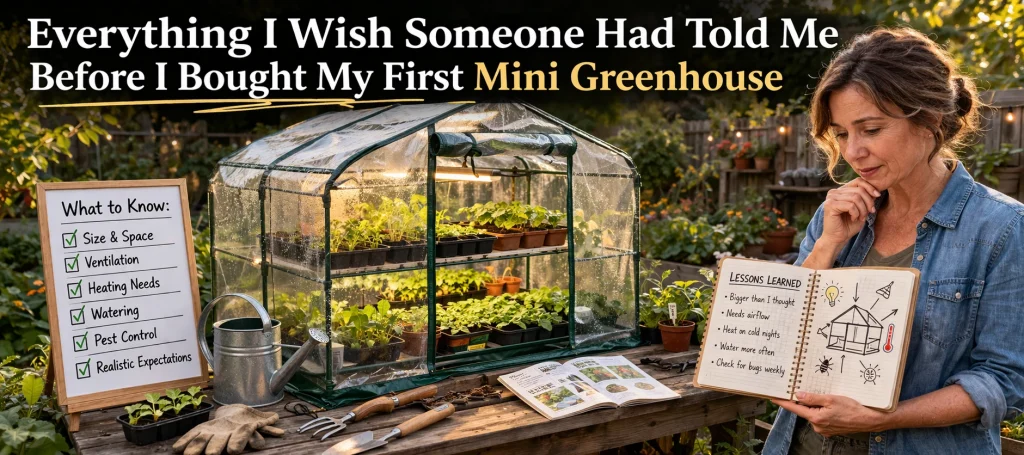
Most buyers underestimate ventilation when comparing models at the point of purchase. It is not enough to have one roof vent. A door that opens completely is beneficial, but only if someone is around to open it. Growers consistently choose an automatic vent opener, a wax-filled cylinder that expands with heat and forces the vent open without electricity or human intervention. On days when the weather unexpectedly warms up while the owner is at work, a reliable irrigation system can mean the difference between healthy plants and a crisis. Most first-time buyers are too late to purchase one at the same time as the greenhouse, rather than after the first near-miss.
Size is another constant regret. A 4×6 model appears suitable in the garden center. The garden appears sufficient before anything is added. In late April, the building looks full and the growing season hasn’t even begun, with seed trays on every shelf, a propagator on the floor, and space set aside for tomatoes to be planted in May. Growers’ standard advice, which is to buy the next size up from whatever you think you need, has almost become a rule among experienced growers. A 6×8 model that feels a little big in March will feel right by June. It is important to consider shelving that can be removed when tall plants require the vertical space in the specification rather than fixed shelving that cannot be modified.
Understanding the framework and glazing materials before purchasing is better than afterward. The powder-coated aluminum frames are the better option since they don’t corrode like unfinished aluminum, don’t warp like wood in humid environments, and only require occasional cleaning. When exposed to UV light, low-cost plastic-coated frames deteriorate and need to be replaced in two to three seasons, turning what initially appeared to be a bargain into an ongoing expense. When it comes to glazing, twin-wall polycarbonate panels perform better than both single-layer plastic sheeting and glass in most practical aspects, including improved light diffusion for mature plants, better insulation, and no risk of shattering from hail or wind-blown debris. Initially, it is more expensive. Long-term math is usually straightforward.
Anchoring isn’t given the serious consideration it deserves by most buyers. A lightweight polycarbonate greenhouse with plant trays inside is sufficiently stable in still weather. When a wind event occurs, a structure without adequate anchoring becomes dangerous. A skilled owner will fix the whole frame into the ground via a timber base, drive corkscrew anchors into the ground, or use heavy-duty ground stakes. In comparison to replacing a structure that has been moved or damaged by wind, the expense and effort involved are negligible. The interior floor, which is made of pea gravel rather than bare soil, is another feature that distinguishes buildings with manageable slug problems, mud underfoot during rainy months, and drainage problems.
First-time greenhouse owners often repeat the same themes when reflecting on their early mistakes. There is not enough. The weather is too hot. Ventilation was underestimated. Structure that is not anchored. In less than two weeks, a whitefly-carrying plant brought in from the garden in October spread to each tomato. There is no mystery to these mistakes. They are inevitable consequences of purchasing a product without fully understanding the system it introduces. Structure-wise, it’s fairly straightforward. In order to use one effectively, you need a different kind of knowledge, which, regrettably, usually comes when it is most needed.