
In a well-kept Southern garden in July, where the owner is out before 7 a.m. with a hose in hand, muttering about aphids, you will eventually see them. Almost ridiculously bright clusters of flowers bursting from a hanging basket or pressed up against a fence seem far too joyful to wither in the kind of heat that kills everything else. The SunPatiens have been subtly changing summer gardening rules for the past ten years or so.
Interestingly, the story begins with failure. For many years, Impatiens walleriana, the type your grandmother grew in every corner of her garden, was the preferred choice for year-round summer color. They were simple, affordable, and dependable in the shade. In the early 2010s, downy mildew ravaged gardens across the country, killing millions of plants. There was a pervasive sense of annoyance among gardeners left with muddy, bare beds. The industry demanded better. The solution might have been a hybrid that loved the sun.
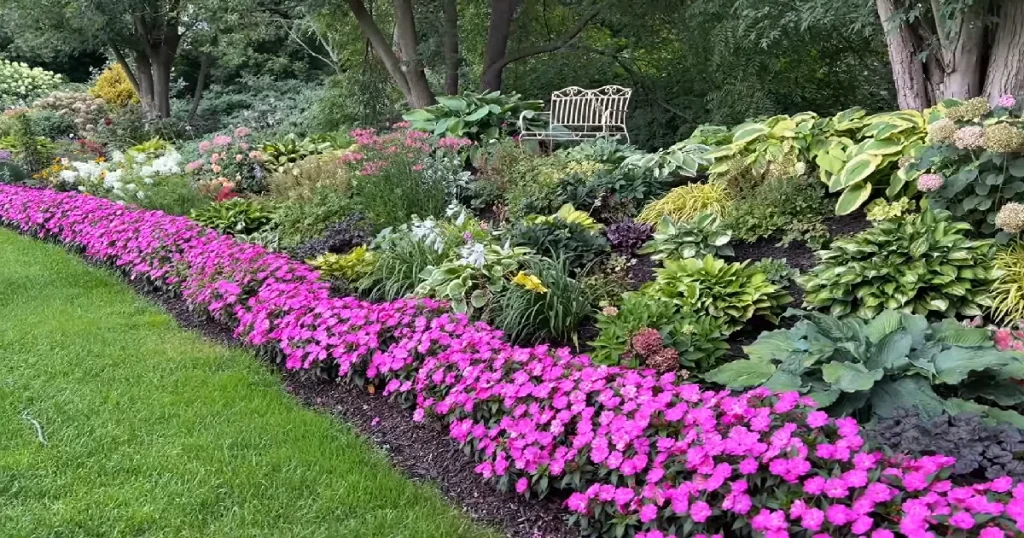
In order to create SunPatiens, the traditional garden impatiens and the New Guinean species Impatiens hawkeri were crossed. To create something that could flourish in full sun during a Mississippi August, the breeding goal was to combine the New Guinea type’s heat and sun tolerance with the traditional plant’s prolific blooming habit. The first time growers made these claims, many seasoned gardeners were skeptical. Are there flowers that thrive in full sun and never stop blooming? I thought it sounded like advertising copy. People grew them then.
The SunPatiens’ ability to manage actual summer conditions without drama is what really sets them apart. Instead of sulking, bleaching out, and collapsing, SunPatiens lean into direct sunlight. With more light, they bloom more profusely and grow faster. In a sunny border, a well-established plant can bloom continuously for 240 days from late spring planting until the first hard frost. Those who keep track of these things have repeatedly recorded this figure, so it is not exaggerated.
By late August, SunPatiens appear to be oblivious to the heat. The SunPatiens simply keep producing even when other flowers seem to be struggling-petunias are getting lanky, marigolds are fading, everything seems a little desperate. Because new buds form as quickly as old ones fall, there is a constant, almost pushy abundance. The blooms are also large. They are larger than conventional impatiens and come in a variety of colors, including coral, hot pink, electric orange, deep red, and clean white. Even without flowers, they have some interesting variegated foliage options.
Depending on the gardener’s goals, there are three main series: Compact, Spreading, and Vigorous. Suitable for neat borders and containers, compact varieties reach a maximum height of 18 to 24 inches. People stop in their tracks when they see a basket of “Pink Flash” in full bloom. Almost theatrically, spreading types fill hanging baskets wider than tall types. Lastly, there is the Vigorous series. Fast-growing shrubs, they reach heights of over three feet and spread almost as wide as annuals. Several SunPatiens can cover an area in a large landscape bed that would otherwise require a small army of common bedding plants.
Care is the key to establishing a reputation. SunPatiens require very little assistance once they are established. The spent flowers fall off neatly and are replaced so quickly that the space between them is hardly noticeable. Pruning is not necessary unless a vigorous plant begins to encroach on its neighbors, which happens. There is no need for fertilizer; a slow-release granular applied at planting or a liquid feed applied roughly every three weeks will suffice. What they really need is consistent moisture. Although they are not xeriscaping plants, they are more drought-tolerant than traditional impatiens. In hot weather, they need water two or three times a week, and if you leave them dry, they will wilt. With water, they quickly recover, however.
The SunPatiens’ popularity coincides with a more general change in gardeners’ perspectives on maintenance. This approach replaces the previous one, which involved fussing, deadheading, and spraying. They want color, they want it to last, and they don’t want to deal with it every weekend. The SunPatiens are ideal for this purpose. Additionally, they are resistant to downy mildew, which wiped out their predecessors in areas where the pathogen persists in the soil. In addition to disease resistance, the extended bloom season and sun tolerance are extra benefits.
However, it’s important to acknowledge that they aren’t completely problem-free. A high number of thrips can leave scars on the foliage, and spider mites can occasionally appear, especially during hot and dry weather. Overwatering and poorly drained soil are the causes of root rot, which is surprisingly common among gardeners who overcorrect and associate impatiens with moist conditions. Underwatering or excessive fertilizer can lead to brown, scorched patches, while drainage or watering problems can result in yellow leaves. All of these problems are not unique to flowering annuals, and once identified, none are particularly difficult to resolve. At the moment, the most important thing is to avoid planting them near water. Even so, it remains unclear whether breeding efforts will eventually produce root pathogen-resistant varieties.
| SUNPATIENS — IMPORTANT INFORMATION | |
| Common Name | SunPatiens |
| Botanical Name | Impatiens x hybrida SunPatiens® |
| Plant Family | Balsaminaceae |
| Plant Type | Annual (Perennial in Zones 10–12) |
| Mature Size | 14–42 in. tall, 14–36 in. wide |
| Sun Exposure | Full sun to full shade |
| Soil Type | Moist, well-drained; amended with organic matter |
| Soil pH | Acidic to neutral (5.8–7.0) |
| Bloom Time | Spring through fall (up to 240 days) |
| Flower Colors | White, pink, orange, red, purple, lilac |
| Key Varieties | Compact, Spreading, Vigorous |
| Disease Resistance | Resistant to downy mildew |
| Maintenance | No deadheading or pruning required |
| Hardiness Zones | USDA Zones 10–12 (annual elsewhere) |
| Official Website | sunpatiens.com |
One restriction that gardeners who wish to stretch their budget should be aware of is that SunPatiens are trademarked plants and cannot be propagated legally. In order to reduce the cost of planting the following year, cuttings cannot be rooted over the winter. Buying new plants every spring is acceptable for most people, but for those who treat their gardens as self-sustaining systems, it feels restrictive. In frost-free regions like southern Florida, the plants will endure as perennials, returning year after year without any assistance. They are, however, annuals for the majority of the nation, which implies that they must be purchased every year.
Based on the plant’s development over the last ten years, SunPatiens may be one of those underappreciated horticultural achievements outside the gardening community. Although it may seem insignificant, Mississippi’s Medallion Award in 2011 indicates significant real-world performance since the tests are conducted in harsh summer weather rather than climate-controlled conditions. The plant earned the recognition. Those who have been burned by the limitations of traditional impatiens or who have had difficulty finding consistent color for sunny spots would probably grow more impatiens if they knew what they were getting. Although SunPatiens is a simple enough name, the whole picture is even more impressive than the name suggests.
As a Senior Editor at Mini Greenhouse Kits, Hannah Kinsley is a passionate supporter of small-space gardening and urban gardening. Hannah, who is currently majoring in Environmental Policy through the University of Michigan’s Environmental Studies program, infuses her writing with a solid academic foundation and a sincere enthusiasm for the environment. You can find her playing soccer or exploring the city’s green areas with friends when she’s not researching the newest trends in city gardening or creating content for minigreenhousekits.com.