
The first week is not warned to you. The pantry shelves are stocked, the garden is producing, and then all of a sudden the zucchini arrives, followed three days later by the tomatoes, and nearly instantly by the beans, and all of a sudden the kitchen is no longer a kitchen. There is a delay in the processing facility. As it turns out, the clock is not a metaphor. Produce deteriorates quickly after harvest, and a lot of work and food are lost between harvesting and using it.
Food-growing and preservation challenges often reveal that the garden is only half of the problem, not the garden itself. Harvesting, cooking, canning, dehydrating, deciding what to freeze, what to process first, and what won’t keep are all labor-intensive processes. It might be even more challenging since it is time-sensitive in a way that planting is not. One day after planting a seed, it will still sprout. A basket of ripe peaches on the counter won’t wait for a convenient time.
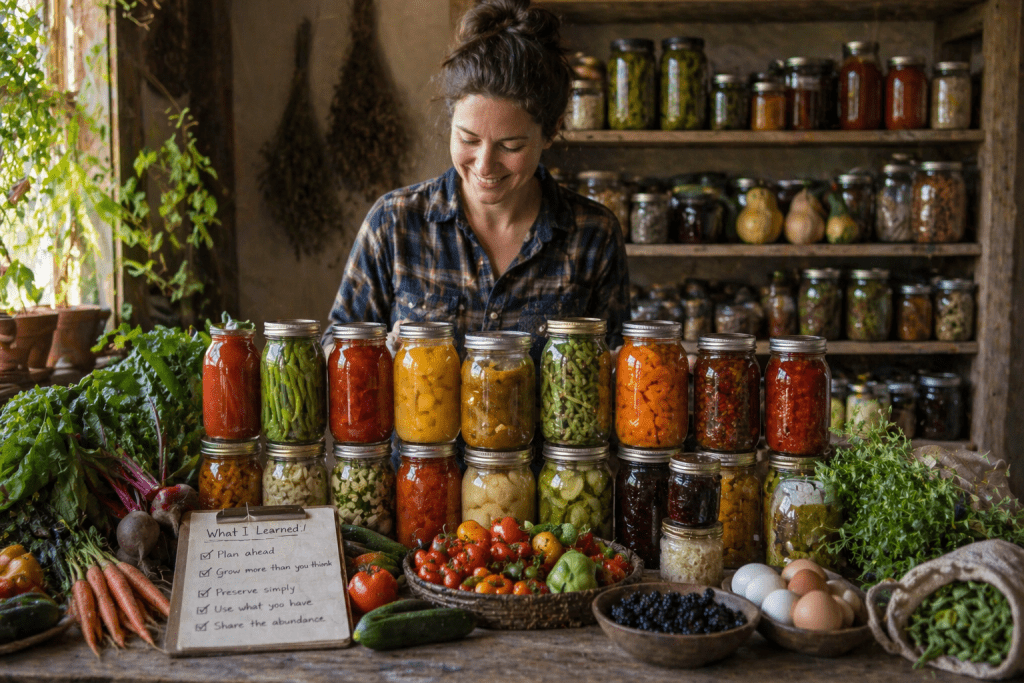
Their 90-day no-shopping challenge, which involved living solely off of garden produce and stored food from July through mid-October, altered their perception of the true cost of food. In terms of time and attention rather than money, they estimated that they would save about $700 over three months. Bread had to be baked. For butter, cow’s milk was bartered from a neighbor and occasionally churned. The beans had to be soaked the night before. It was impossible to stop quickly. Before the new rhythm took hold, inadequate preparation resulted in hunger, which occurred multiple times in the initial weeks.
Novices are somewhat alarmed when they learn about the bumper crop issue, as experienced preservers are familiar with it. It is necessary to take action quickly when a plant that was only moderately productive all summer suddenly produces two weeks of abundance. When you blanch, peel, bottle, and process fifty pounds of tomatoes in a water bath canner in a single weekend, it is truly exhausting. It’s also gratifying in a unique, palpable way. When you see a shelf filled with quart jars of tomatoes in late August, you feel a sense of security. Something significant has been accomplished that relates to a very ancient understanding of seasons and scarcity.
Moreover, the problem revealed how inadequately conventional food storage plans handle fats. Cooking from scratch requires more oil, butter, and rendered fat than a typical modern family would stock in its kitchen. The family ran out of butter within the first month of the challenge. In order to churn their own milk, they had to barter for milk from a neighbor’s cow. It is important to have basic necessities, but they are tedious to consider. Almost every kitchen contains salt, flour, oil, sugar, baking soda, and enough fat for cooking; if you count honestly, most pantries contain three weeks’ worth.
It takes careful consideration to match preservation techniques to the food and what the family will actually consume, since most novice gardeners are unaware of the importance of preservation techniques. If you don’t like the texture of dehydrated greens, for instance, you won’t voluntarily eat it. Preserving a lot of something no one likes is a waste of time, effort, and jars. Families that are successful at long-term food preservation typically start with the foods they already cook and work their way out.
| Category | Details |
| Challenge Type | 90-day no-shopping food challenge (garden + food storage only) |
| Duration | July 21 – October 18 |
| Primary Sources | Home food storage, garden produce, and bartering with neighbors |
| Family Size | Large family (with additional guests adding up to double the anticipated headcount) |
| Estimated Money Saved | Approximately $700 over 90 days |
| Weight Change | Adults lost 5–6 lbs each; attributed to elimination of processed and fast food |
| Preservation Methods Used | Canning/bottling, dehydrating, freezing, root cellaring, fermentation |
| Shelf Life: Home-Bottled/Canned | 18 months to 2 years (40% nutritional retention) |
| Shelf Life: Frozen Produce | Up to 1 year (60% nutritional retention if promptly frozen) |
| Shelf Life: Dehydrated Produce | 6 months to 1 year (80% nutritional retention) |
| Critical Timing Rule | All produce begins deteriorating within one hour of harvest |
| Key Lesson | Preservation and cooking represent at least half the total labor of food production |
| Items Most Regretted Not Storing More Of | Butter, fats/oils, chocolate, basic staples (flour, sugar, salt) |
| Reference | National Center for Home Food Preservation – USDA |
There is a larger cultural observation beneath all of this. Throughout agricultural history, harvesting, pickling, drying, canning, fermenting, cooking, and storing were regarded as equally important and impactful as cultivation. It took years to develop both skills. They both deserved to be counted. The modern tendency to celebrate the garden while treating the kitchen work as incidental may explain why many food-growing projects end with beautiful harvests being wasted on back porches. Tomatoes survived. It didn’t go as planned with the tomatoes.
It took the family ninety days to develop a more sophisticated storage strategy, a list of items they should stock more of and those they should discard entirely, and a new perspective on food waste. There was very little waste. For what could not be used, bartering was used. Items that could not be traded were composted. After experiencing self-sufficiency, self-reliance didn’t seem simple. It gave the impression that it was feasible, which is more accurate.
As a Senior Editor at Mini Greenhouse Kits, Hannah Kinsley is a passionate supporter of small-space gardening and urban gardening. Hannah, who is currently majoring in Environmental Policy through the University of Michigan’s Environmental Studies program, infuses her writing with a solid academic foundation and a sincere enthusiasm for the environment. You can find her playing soccer or exploring the city’s green areas with friends when she’s not researching the newest trends in city gardening or creating content for minigreenhousekits.com.