
An outdoor greenhouse that was supposed to produce abundantly in July instead produces thin yields, yellowing plants, and flowers that hopefully bloom before dropping without setting fruit. It causes a certain amount of frustration. There is still no damage to the building. There is still life in the plants. There was something wrong somewhere, and it usually occurred covertly before it became apparent. In the gardener’s opinion, plants don’t cooperate because of the weather, the seed, or a vague feeling. Almost always, there is a much more manageable explanation.
Overwatering is the most common cause of greenhouse plant failure for all crops and skill levels. In an enclosed structure, water cannot escape. Rot develops within days as it sits in the compost around roots, removing oxygen from the areas where roots need it. Yellowing lower leaves, soft stems at the base, and slightly sour compost mimic drought stress, so adding more water exacerbates the problem. After inserting a finger two centimeters into the compost, reach for the watering can. If it’s still wet, leave it. With a soil moisture meter that costs less than ten pounds, all uncertainty is eliminated and plants are saved in just one season.
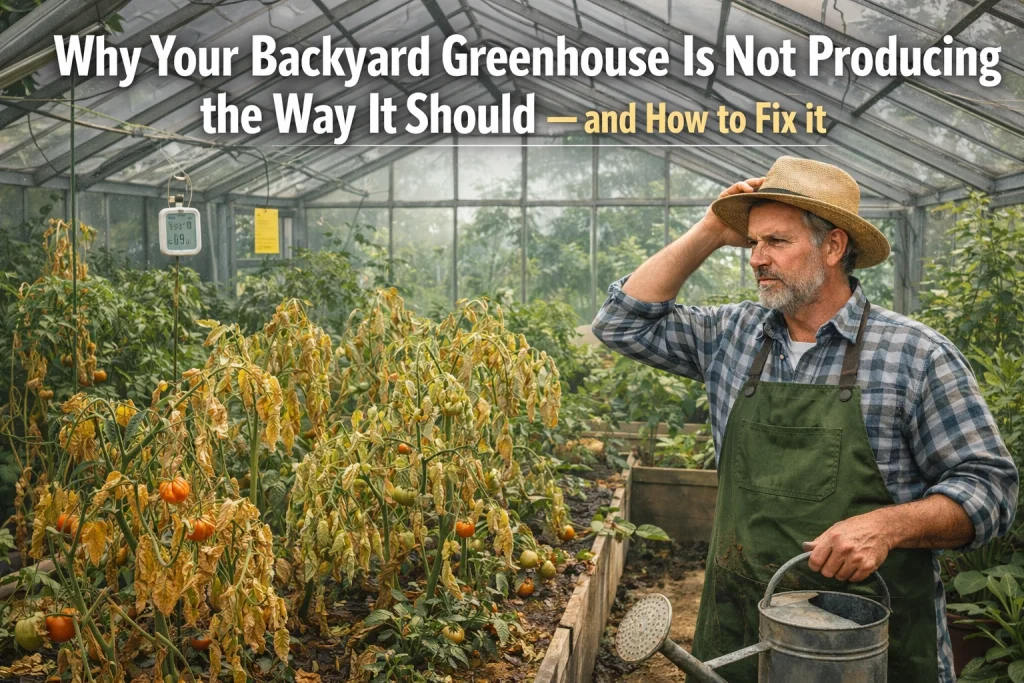
Ventilation ranks second on the list of failures, and the two issues are interconnected. The temperature in a closed greenhouse can reach 50°C by midday on a clear June morning. Despite moderate conditions, these temperatures cause tomato flowers to abort rather than set, scorch leaf tissue permanently, and stress plants so much that they cease to produce. When the interior temperature reaches 18°C, open roof vents, open doors and side louvres, and open everything when it reaches 27°C. The problem with automatic vent openers is that they require someone to be present and pay attention at the right moment on any given morning, as they use heat-expanded wax cylinders that do not require electricity. For people who cannot monitor their greenhouse during the hottest hours, this is a practical solution. For a 6×8 greenhouse, two are required.
Pollination failure occurs invisibly and consistently outdoors, surprising growers who weren’t expecting it. In a sealed greenhouse, the wind and bees that do most of the work are not present. The flowers of tomatoes, peppers, cucumbers, and strawberries open and then fall without bearing fruit, leaving the grower to wonder why seemingly healthy plants are not producing. To release pollen, either use a fine paintbrush to move pollen between flowers or gently shake flowering stems every day at noon. Pollination and stagnant, disease-prone air are greatly improved by a small fan placed to create gentle air movement throughout a structure.
Overcrowding is a problem that appears gradually and is easy to ignore in its early stages. In April, a greenhouse with plenty of space appears sparse. A half-empty shelf, a small plant, and the temptation to add more are all understandable and common. By July, what looked like sufficient spacing has become a dense mass of foliage where fungal diseases spread easily between plants, air cannot circulate, and light cannot reach the lower leaves. Tomatoes should be spaced 45 centimeters apart. It takes sixty cucumbers to produce one cucumber. In a typical 6×8 greenhouse, six to eight tomato plants can be comfortably housed, but twelve plants produce powdery mildew and botrytis. In February, before a single seed is sown, the generous impulse of April will not produce the yield-cutter of July.
Soil nutrition is a less obvious but consistently underappreciated factor in poor performance. The same compost from the previous season is often used by growers without amendment, fertilizer is applied inconsistently, or fertilizer is applied too early, leading to leafy growth at the expense of fruit. However, greenhouse plants in containers or borders produce more intensively and exhaust nutrients faster than outdoor crops. You should know the difference between multipurpose compost and seed compost before the season starts: multipurpose compost is too rich and coarse for seeds, resulting in either rot or fertilizer burn, while seed compost is finely sieved and low in nutrients. Once plants are in flower, a weekly high-potash liquid feed promotes fruit development, but not before.
Most causes of greenhouse underperformance have one thing in common: the enclosed structure magnifies both its advantages and its shortcomings. When ventilation is neglected, the same warmth that prolongs the season also raises temperatures to dangerous levels. The same moisture retention that lowers watering frequency also causes root rot if watering is done according to a schedule rather than according to the soil condition. Those that manage to get inside to breed benefit from the same defense against outdoor pests. Backyard greenhouses reward active management and penalize passive assumption, in contrast to most outdoor growing. To fully understand this relationship, it takes a season or two.