
A general practitioner’s office in Lambeth, south London, has been experiencing something unusual for some time. Patients who arrive with depression, anxiety, or the kind of worn-out disconnection that doesn’t neatly fit into any diagnostic category are referred to the community garden instead of receiving antidepressants. Thirteen general practitioners in the area have sent their patients to dig, plant, and tend alongside others in comparable circumstances. The results have been subtly positive by the majority of significant metrics, and the model is gaining traction.
As a matter of fact, a green prescription looks like this. In the last ten years, the term has moved from alternative medicine’s periphery to the language of NHS commissioners, government health initiatives, and peer-reviewed research. A New Zealand physician was the first to formalize and integrate the approach into the country’s healthcare system as a standard practice rather than a trial in the late 1990s. Four Canadian provinces followed suit, allowing doctors to prescribe nature in exchange for free park admission. Japan has made forest bathing, or shinrin-yoku, a national health initiative since 1982. Doctors have recommended woodland walking trails that have cost millions of dollars. There is a constant direction of travel worldwide.
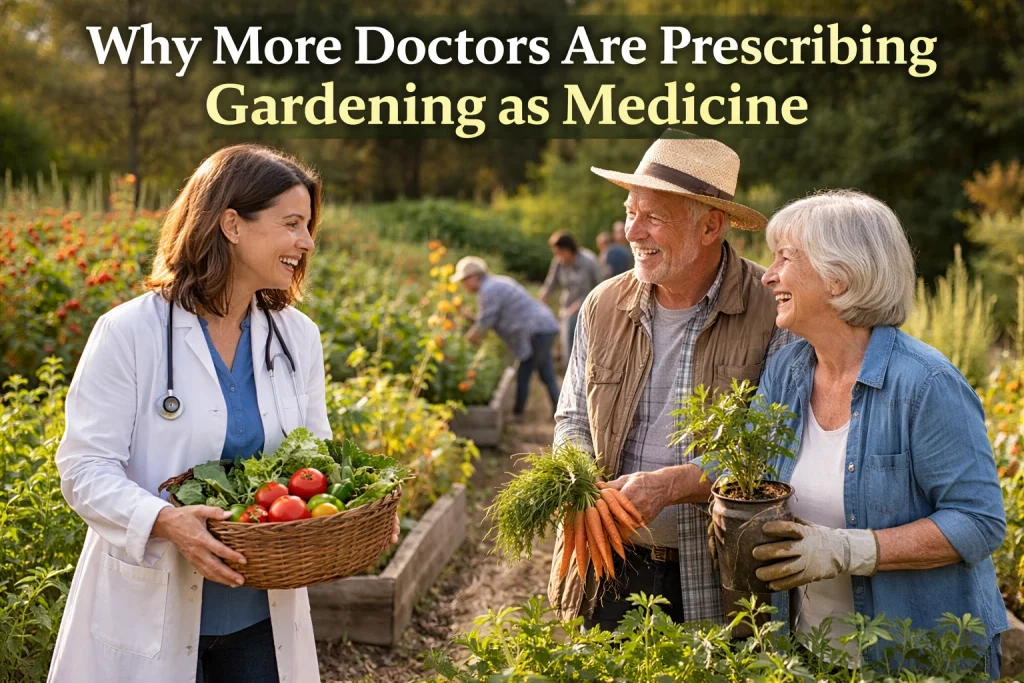
Spending time outside is generally perceived as enjoyable, but the physiological explanation is more specific. Spending two hours a week in nature has consistently been shown to improve health outcomes over the past 20 years. After comparatively short exposure to green areas, cortisol, the hormone most closely associated with long-term stress, decreases. Finnish studies have observed that walking in a city park for fifteen minutes improves vitality and energy. Contact with soil microbes appears to train the immune system in ways that cannot be replicated in today’s sterile indoor environments. It is no longer considered fringe research; a meta-analysis published by the National Institutes of Health in 2024, which was referenced by almost eighty other studies, consistently found that gardening improved mental health, quality of life, and overall health.
As opposed to simple nature exposure, gardening provides a combination of elements that make it particularly beneficial as a clinical intervention. Rehabilitation patients recovering from heart attacks, strokes, or cancer treatment need low-impact exercise because their bodies cannot sustain high-intensity exercise. The focus on something external and living, in contrast to passive relaxation, disrupts ruminative thought patterns associated with anxiety and depression. Creating something, such as food, flowers, or a cultivated area, fosters a sense of competence and purpose that isolation tends to undermine. When it takes place in a community setting, it also addresses loneliness, which has been shown to be a health risk similar to smoking fifteen cigarettes a day.
Medical establishments are catching up to something gardeners have always understood intuitively, observing this development in various healthcare systems. The language of green prescriptions, social prescribing, and therapeutic horticulture may be new, but the underlying observation remains the same. Healing was the purpose of monastic gardens. Hospital gardens were common in Victorian hospitals before the pharmaceutical era reorganized medicine around medications and procedures. In collaboration with local mental health teams, veterans’ associations, and educational institutions, the Rainbow Community Garden in Hull is participating in a study that aims to quantify what its participants would likely already describe: that frequent attendance at a shared growing space alters people’s perceptions of themselves and their lives.
There are genuine challenges that deserve recognition. In a time when local governments are finding it difficult to maintain public parks, the long-term viability of community gardens is seriously questioned. Additionally, compared to pharmaceutical prescriptions, green prescriptions require a different kind of infrastructure, such as referral pathways, social prescribing link workers with training, and accessible locations that are reasonably close to patients who may not own a car or have mobility issues. Rather than adding the strategy as a choice that patients must figure out on their own and that general practitioners can suggest on their own, the strategy functions best when integrated into a system that facilitates it.
In spite of this, the path seems fairly obvious. Humanity’s greatest source of health and well-being is nature, according to the World Health Organization. It would have sounded vague in a clinical document twenty years ago, but it now appears in policy documents. According to Harvard research, green spaces are associated with longer life expectancy. According to Canadian data, adding ten trees to a city block improved residents’ perceptions of their health as much as increasing income by $10,000 or getting seven years younger. The implications of this research, including how cities are planned, how healthcare is provided, and what constitutes a valid medical intervention, may take another generation to fully comprehend. Lambeth’s gardens, however, are already open.