
Hobby greenhouse growers seldom discuss the type of loss that occurs while they’re at work or running errands on a typical Tuesday in June. When they open the greenhouse door at home, they discover tomato plants with a slumped, defeated expression, leaves curled at the edges, and shoots that have collapsed. They search for pests. Watering interests them. There is hardly any thought given to the air, or more specifically, the lack of sufficient air flowing through the room at the appropriate time.
Among the main advantages of small greenhouses is their ability to protect delicate plants, prolong the growing season, and cultivate plants that wouldn’t thrive in a garden in Britain or northern Europe. There is truth in that promise. The ventilation provided in most hobby models is far insufficient for the temperatures a glass or polycarbonate structure can reach on an unexpectedly warm spring day, which is often overlooked in marketing materials. According to the Royal Horticultural Society, the minimum vent-to-floor ratio is 20%, which is one square meter of opening for every five square meters of floor. An average 6×8 greenhouse requires approximately 0.9 square meters of ventilation. Most come with a single roof vent covering roughly 0.3. If there is a gap between what is required and what is supplied, plants will perish.
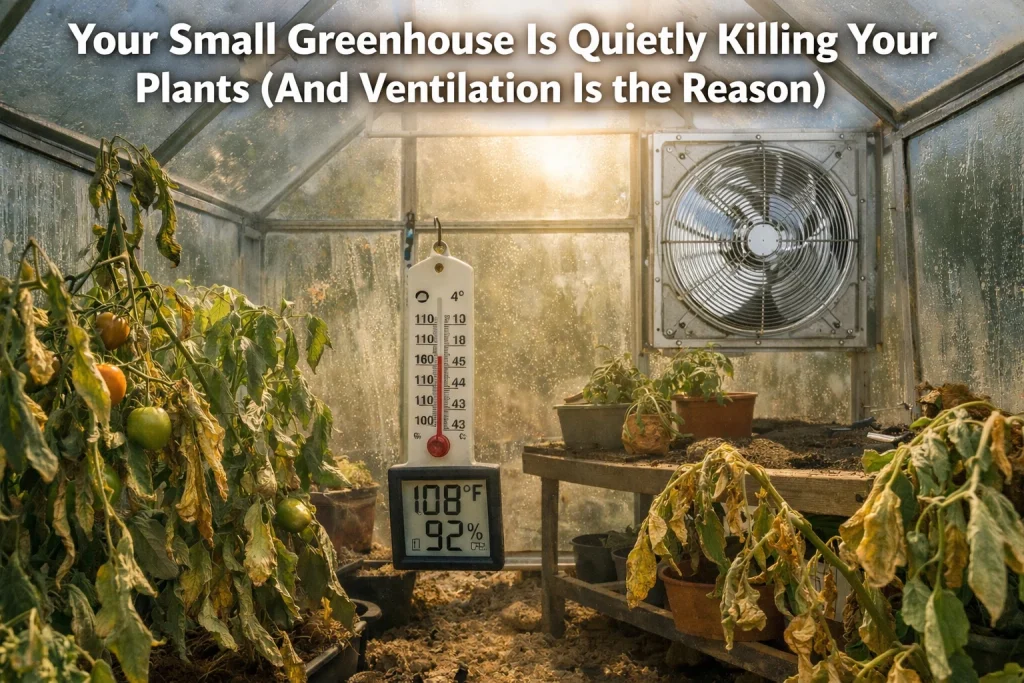
Why is this still the standard in 2026? 20% is not a new percentage. Since many years, it has been the accepted professional standard in commercial glasshouses, where the economics of losing a crop make the calculation simple. Hobby greenhouses, on the other hand, operate in a different market where buyers place a higher value on growing space per square foot than airflow. This is well known to manufacturers. The product functions well in moderate weather, but becomes dangerous in warmer weather. Stress in plants begins when the internal temperature rises above 27°C, which can happen before 10 a.m. in June. Above 30°C, damage increases noticeably. Many growers report that their plants appear to be suffering from a severe drought, despite the fact that they were just watered. Not thirst, but heat.
In order to find a solution to a problem, it is important to understand the problem’s physics. Heat builds up at the top of the structure. There is no incoming flow to propel air when there is only one roof vent as an exit. In the stack effect, cooler air enters at ground level through louvre vents on the side walls, while warm air escapes at the top of the stack. As a chimney, it works the same way. Since the updraft is continuous and natural, electricity is not needed.
On calm days without wind, even a wide-open roof vent is ineffective without that low-level intake.
An automatic vent opener is an obvious partial solution. As the temperature rises, a wax cylinder expands and pushes the vent open. There is no programming or wiring involved.
There is, however, a significant drawback: the wax takes about fifteen to twenty minutes to react. A small greenhouse can reach danger temperature in less time than that on a hot morning. Growers who use only automatic openers and keep everything else closed create delayed traps. Professionals usually use the opener as a backup rather than their first line of defense on any morning that looks like it might get warm.
Growing experts often mention wetting the floor in their discussions, but it sounds almost too simple to be worth mentioning. On hot days, damping down, in which water is splashed on the path and gravel surfaces inside the greenhouse two or three times, triggers evaporative cooling, which can reduce the air temperature by several degrees in minutes. In addition, it suppresses spider mites, which thrive in hot, dry climates and can destroy cucumber or pepper crops quickly. The combination of floor moisture and open vents creates a microclimate that skilled growers can almost instinctively control by midsummer.
Despite popular belief, winter is not the best time to close everything. In small greenhouses, stagnant damp air poses a greater threat than cold temperatures because grey mold thrives in humid, unventilated conditions. In dry winter days, a single roof vent cracked for an hour or two at noon provides little warmth and eliminates the moisture botrytis needs to grow.
The greenhouse that is currently in most back gardens has probably never been warm enough until it suddenly becomes a problem. If growers do not have a maximum-minimum thermometer that records the daily peaks, they do not know the actual temperatures that their plants can withstand. Theorists speculate. Estimates are often overly optimistic. As a result, optimism has a poor history in structures designed to retain heat.