
On a February morning, when you walk into your greenhouse and discover that your seedlings have turned black around the edges, you can be very frustrated. You purchased the heater. The device was plugged in. You thought you had resolved the issue. Most of the time, the heater has nothing to do with the problem.
Those who have been in this business long enough to have killed a few crops and learned from them tell you to insulate first, then heat. The importance of the order is often overlooked by novices. Heat is lost about half as much when horticultural bubble wrap is applied to the inside walls of a 6-by-8-foot structure. By reducing the size and cost of the heater required, that one step reduces a 2.5kW requirement to something closer to 1.8kW in a well-sealed structure. By saving money on the heater, the insulation is typically paid for multiple times over.
Most first-time greenhouse owners do not pay much attention to the base, where most heat is lost. Through openings at the foundation’s perimeter, cold air enters and takes away whatever warmth the heater just created. Solid concrete or timber foundation anchoring and foam stripping along the door frame are unglamorous solutions that typically outperform a more potent heater in a leaky structure. Only those who have already made a mistake are aware of this kind of detail.
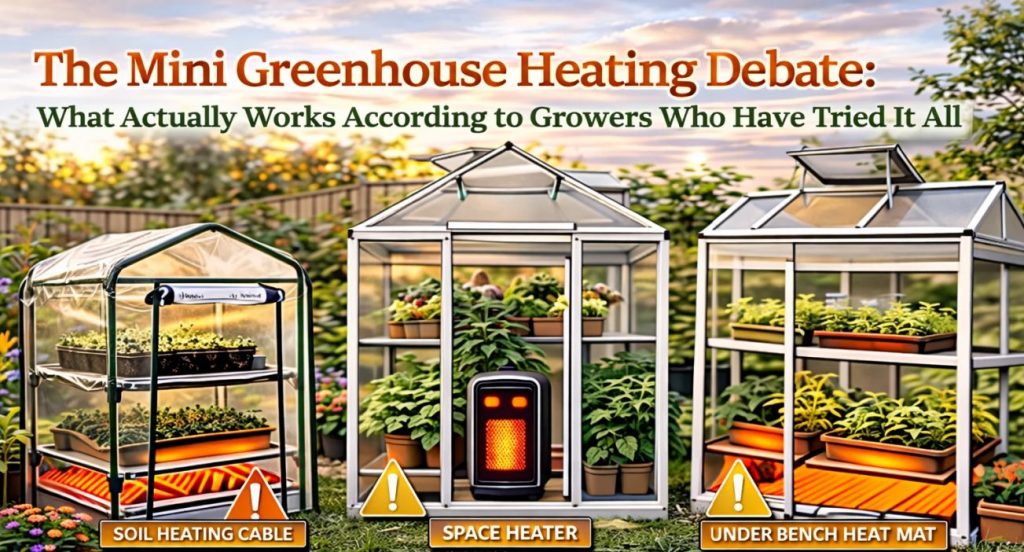
Electric fan heaters are still the most commonly recommended choice for small spaces if you have access to electricity. A thermostatically controlled 1.8kW or 2kW fan heater efficiently covers a 6-by-8-foot or 8-by-10-foot greenhouse, disperses heat uniformly, and reduces humidity. The reason for this is that damp, stagnant air promotes fungal disease, which can kill an entire crop very quickly. In spite of the fact that they heat up more slowly and don’t provide the same circulation benefit, oil-filled radiators are praised for being safe, quiet, and weatherproof. The thermostat cannot be compromised on either device. A thermostat set to maintain 45 degrees Fahrenheit effectively protects against frost without running more than necessary. During a cold night, running a heater continuously can result in alarming electricity bills.
When it comes to off-grid greenhouse growing solutions, propane is the main topic of discussion. During power outages, propane provides a level of dependability that electrical heating can’t match in areas with frequent hard freezes. A 4kW propane heater can handle a structure up to 10 by 12 feet without strain. Ventilation has consistently been a concern among experienced users. Gas combustion produces water vapor, and a sealed greenhouse with a propane heater running all night produces enough humidity to cause mildew and botrytis to grow on foliage. Most people solve this problem by slightly opening the roof vent, which costs some heat but is less expensive than losing a crop to rot.
Many growers give up on paraffin heaters after a season, while others swear by them. Productivity is high. Since they do not require electricity, they have kept allotment greenhouses free of frost for generations. Also, they require daily maintenance, such as flame monitoring, reservoir replenishment, and burner cleaning. Someone who checks the greenhouse every morning doesn’t care about that. Leaving a building unattended for an extended period of time poses a significant risk.
Passive heating techniques are the subject of the most fascinating discussions. Water barrels, which are essentially black plastic containers or recycled 55-gallon drums lined along the north wall, have been used in greenhouses for many years. By absorbing solar radiation during the day and releasing it gradually after dark, water mitigates the impact of overnight temperature drops without incurring any operating costs. Combined with adequate insulation, they can reduce the effort required of a backup heater, but they won’t stop a hard freeze on their own. Hot compost piles placed inside greenhouses may be even more effective. During decomposition, organic material produces measurable heat, which can raise indoor temperatures by 10 to 20 degrees Fahrenheit while releasing moisture and CO2.
Almost always, growers with the strongest heaters lose the fewest plants during the winter. Their thermal mass was carefully placed, walls were lined, openings were sealed, and a small backup thermostat was installed. Lastly, there is the heating itself. Everything that comes before the heating determines its effectiveness.