
The third week into a hydroponically grown lettuce crop, you begin to notice something isn’t quite right. The leaves are larger than they should be. There is a more intense hue. There is an aggressive growth of the plant, as if something is pushing it from below. When compared to a nearby pot of soil-grown seedlings, the difference is noticeable. It’s almost unnerving.
People tend to be put off by that difference-30 to 50 percent faster growth, consistently reported across dozens of crop varieties. It may sound like marketing jargon until you see it in action. The biology underlying the findings is simpler than the findings suggest, and it begins with one unsettling fact about how plants actually use energy in soil.
Plants that grow in soil are foraging in a significant sense. Its root system continuously grows, searching for pockets of water, phosphorus, potassium, and nitrogen in the soil rather than producing. In a well-designed hydroponic system, that search ends before it even begins. Throughout the growth cycle, the root zone receives a water-based nutrient solution precisely calibrated to meet the needs of the plant. Outward spread of the roots ceases. Their size remains small. Moreover, the energy that would have been used to build a vast underground network is instead used to produce leaves, stems, flowers, and fruit.
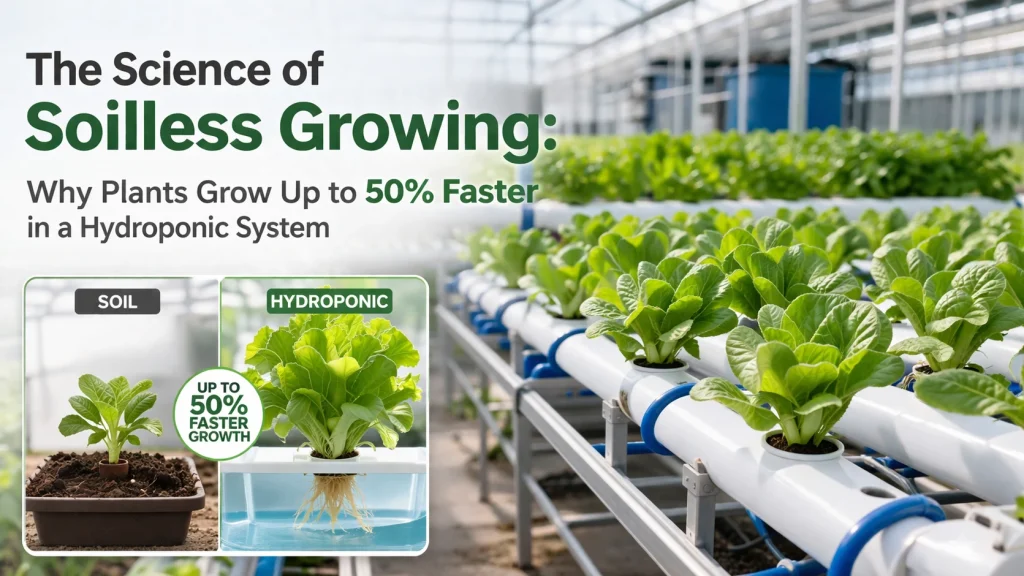
A series of tiny efficiencies may explain the speed advantage rather than a single mechanism. The amount of oxygen in the root zone can be precisely controlled, and roots that are better-aerated breathe more effectively, accelerating their metabolism. A pH range of 5.5 to 6.5 is ideal for nutrient absorption. No matter how fertile the soil is, if the pH falls outside of this window, the plant will not be able to absorb nutrients. In a hydroponic system, the pH is changed every day by the grower. On an hourly basis occasionally. There is no waiting for the plant.
In a commercial vertical farm, for example, a shipping container growing operation in the Nevada desert or rows of basil growing under pink-purple LED arrays in a climate-controlled warehouse in New Jersey, this gives the impression that agriculture has gradually moved indoors without people noticing. AeroFarms, Bowery Farming, and AppHarvest invested years in creating precisely these kinds of controlled environments, hoping the elimination of pests, weather, and soil variability would result in reliable enough yields. Yields remained stable. Business models were more challenging.
The science is clear, however. Research published through PubMed Central and cited by over 200 subsequent studies shows that soilless systems require about a fifth of the physical space of open-field agriculture to produce comparable output. The land-use advantage alone is approximately fivefold greater. Even more water is saved. Since closed-loop hydroponic systems constantly recirculate their nutrients and lose most of their water through plant transpiration, they use a tenth of the water used in conventional agriculture. There are areas where irrigation is already stressed, such as the Middle East, the American Southwest, and significant portions of sub-Saharan Africa, where these figures are concrete. Viable companies are distinguished from non-viable companies by these factors.
There is still some uncertainty about soilless growing’s role in the larger food system. Electricity consumption is real, setup costs are high, and not every crop benefits equally. Most grain crops are not economically viable under current systems; tomatoes and leafy greens thrive; root vegetables are problematic. There has not been an adequate response to the criticism that hydroponics remains a premium niche – costly to build, energy intensive, and supplying upscale supermarkets and restaurant chefs instead of feeding large populations. I agree with you. In spite of this, the systems continue to advance and research continues to expand.
By delivering nutrients as a fine mist directly to suspended roots instead of via a water bath, the aeroponic system speeds up growth rates even more, up to five times faster than soil under ideal conditions. The number seems unrealistic until you see the roots, which are pale, feathery, and nearly crystalline, unlike soil-grown plants. There is nothing to worry about. I think that’s the idea. Its entire architecture is designed to eliminate conflict.
I can’t help but think that’s a little philosophical. Throughout human history, agriculture has been characterized by the challenge of persuading soil to grow. Rather than conflicting with soil, hydroponics circumvents it. Whether that’s a temporary solution or the beginning of something more permanent is still unclear.