
If you walk past the older plots on any well-known British allotment site, you’ll notice something. As the grower gains experience, the greenhouse becomes cleaner. A water butt is tucked against the back wall to collect rainwater from the gutters, and every shelf is utilized. It isn’t showroom-tidy, but it serves a purpose. More recent entrants, with their glossy catalogs and lofty goals, haven’t discovered what these growers have.
After spending several weeks talking with seasoned allotment holders from all over the UK, who have been on the same plots for eight to thirty years, one thing became clear: a small greenhouse is not a storage shed with better light. The benefits are almost always greater for growers who use it as a climate tool rather than as a convenience. Those who use it to discard pots and trays usually end up with steamed-out mess by June.
Most of them mentioned ventilation first, without being asked and with some emphasis. When you hear the true effects of overheating, it seems clear. On a sunny April morning, the interior of a small, closed greenhouse can reach 40 degrees Celsius without ventilation. In that temperature range, lettuce bolts into something hardly edible, tomato flowers drop without bearing fruit, and seedlings that require six weeks of care are cooked in a matter of hours. The majority of seasoned allotment holders claim that an automatic vent opener, a straightforward wax-cylinder device that costs between £46 and £67 and expands in heat to force open a roof vent without the need for wiring or electricity, was the best investment they have ever made. It works even when you’re not there. It is crucial for a working allotment because no one can guarantee they will be there on an unexpectedly warm April day.
According to most growers, 27 degrees Celsius is the practical ceiling for productive growth. Above that, fruit crops suffer. Below that, the greenhouse makes a living. Newcomers to allotment life are often surprised to learn that summer can be nearly as problematic as winter, but in the opposite direction. Besides the automatic opener, the solution involves moistening the floor, paths, and hard surfaces twice or three times a day to cool the air through evaporation, an antiquated method called “damping down.” Brochures do not contain this kind of information. The answer can be found by observing the actions of the character two plots ahead on a Thursday afternoon in July.
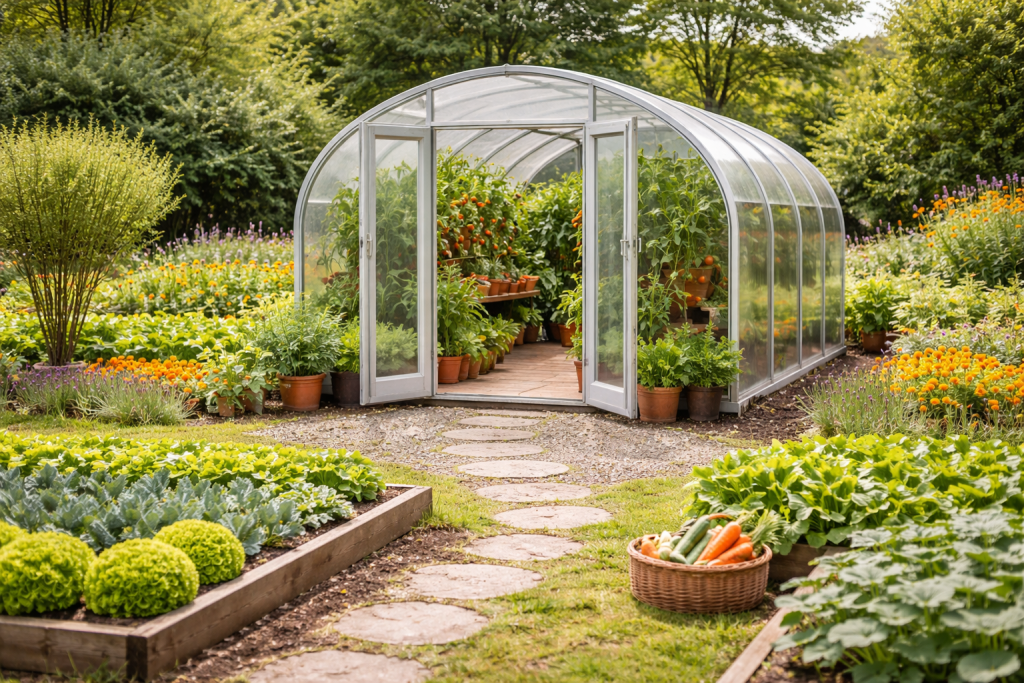
On the size issue, there was surprising consensus. Most UK allotment societies cap structures at 8 by 6 feet, and seasoned growers agree that’s good enough as long as it’s not badly filled. According to nearly all veterans, overcrowding is the second biggest mistake after inadequate ventilation. A 6×8 greenhouse can grow six to eight cordon tomato plants. Due to reduced airflow, fungal disease occurs, resulting in lower yields and more labor. In the first or second season, it is especially tempting to grow everything at once. Growers who have been doing this for decades have figured out how to combat it. When they discuss “little and often” sowing, or small batches every two weeks, they use the same tone that chefs use when discussing mise en place. The key to success is control, not zeal.
Several holders discussed the glazing selection with the quiet conviction of someone who has been burned before. Polycarbonate was unanimously favored over glass on an allotment site. Allotments are more susceptible to vandalism than back gardens because glass cannot withstand it. A grower in the Midlands recalled arriving at her plot one morning to find that every pane in her old glass greenhouse had been broken; she estimated the task had taken her five seconds. She hasn’t experienced a broken panel since using polycarbonate. As a result of its internal air cavity, the material also retains heat more effectively than single-pane glass. According to every seasoned grower surveyed, it transmits about 80% less light than glass, which transmits 90%.
Rather than major accomplishments, veterans had learned a lot from minor setbacks. Most growers make the mistake of reusing potting compost from the previous season once, then never again. In the warm, protected environment of old compost, pests and disease-causing agents thrive. Fresh compost is somewhat expensive every season, but the alternative is more expensive. In the same way, botrytis, a gray mold that spreads rapidly in enclosed humid spaces, is encouraged by watering leaves rather than their bases. The advice given by growers from Yorkshire to Cornwall was nearly identical: water the roots in the morning, not the foliage, and not at night.
According to people who have worked in small allotment greenhouses for years, habits formed around the structure take precedence over the structure itself. The best growers on any site did not always purchase the most expensive models. They learned when to stop packing their staging, when to open the vent, and when to plant a second batch. A few additional weeks were provided to them by the greenhouse at the end of each season. It was what they did with those weeks that made a good harvest different from a mediocre one.