
At first, the change is almost undetectable. Usually installed against a wall with a slight tilt toward the sun, a mini greenhouse arrives in a flat box or as a bundle of lightweight panels. It doesn’t seem like much. The building flutters a little when the wind picks up and is sometimes covered in thin plastic. Things start to change after a few days.
The air inside feels different. Early in spring, when the soil still smells damp and cold, it is noticeably warmer. There is a slight humidity trapped beneath the cover, which causes the interior panels to fog lightly when you get closer. Outside, seeds that might have hesitated begin to push upward, gradually at first, then all at once. It may not be obvious from a distance, but moisture and warmth are subtly altering the rate of growth at the soil level.
The timing seems to be less strict. In the past, gardeners waited for late frosts to pass before planting, sometimes weeks in advance. Watching this unfold feels a little dangerous. Frost hasn’t disappeared, after all. The small greenhouse serves as a buffer, preventing harsh weather conditions from destroying everything. As seedlings become more consistent, they become less brittle and erratic. At least, that’s my impression.
Protection, however, comes with its own set of challenges. As well as keeping pests out, the enclosed area may trap heat excessively. On a sunny afternoon, the temperature inside can rise more quickly than expected, even in mild climates. First-time users often realize that something intended to protect plants can also stress them if left unchecked. Daily tasks like opening the zipper, raising a panel, and modifying the airflow become routines.
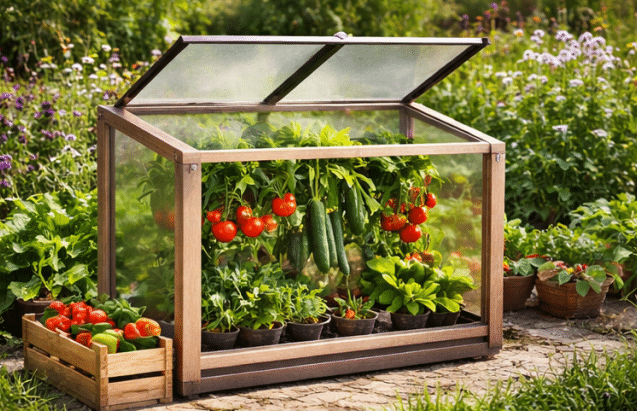
The advantages, however, cannot be ignored. It is common for plants grown in small greenhouses to have thicker stems, appear stronger, and be less susceptible to common problems. It’s not just about survival, it’s about momentum. As a result of being started in these controlled environments, seedlings typically transplant more successfully and adjust to open soil more quickly. It has a subtle efficiency, similar to giving plants an advantage they wouldn’t otherwise have.
In addition, the growing season has been extended, which is like bending time. Early in the year, the greenhouse creates a pocket of it before spring arrives fully. The harvest is prolonged when temperatures start to drop later in the season because it retains warmth for a long time. It takes a little longer for tomatoes to ripen. The herbs last longer than they usually do. While the impact is evident, it is still unclear how much is due to specific circumstances as opposed to basic protection.
However, the limitations become apparent very quickly as well. In comparison with full-sized greenhouses, mini greenhouses lack the same buffer against temperature fluctuations. Due to the reduced air volume, plants may be caught off guard by rapid heating and cooling. It is common to add shelving to make the most of available space, but this creates its own issue: shadows. Plants sometimes reach awkwardly for the little sunlight that does penetrate at lower levels because there is less light.
| Category | Details |
|---|---|
| Topic | Mini Greenhouse Impact on Home Gardening |
| Typical Cost | $50 – $500 |
| Primary Benefit | Season extension & plant protection |
| Best Use | Seed starting, frost protection, small crops |
| Space Requirement | Small patios, balconies, garden corners |
| Climate Advantage | Protects from frost, wind, pests |
| Reference Source | Joe Gardener |
| Website | https://joegardener.com |
Another concern is durability. Many small greenhouses use plastic covers that deteriorate more quickly than expected. After a season or two, they may become brittle, tearing at the edges or coming loose. It’s one of those details that don’t seem important at first, but become crucial as time goes on. Investing in a slightly stronger structure is frequently justified even if it is not always up front.
Despite these flaws, something more subdued emerges. There is an evolution in the relationship between the gardener and the space. Interactions and attention are increased on a daily basis. Watering becomes more intentional when checking humidity, adjusting openings, and watching for condensation. The gardener is practically forced to take on a more active role by this little structure that invites closer inspection.
Early in the season, the shelves suddenly fill up. There are rows of seedlings on trays with slightly overlapping leaves and dark soil from recent irrigation. From the outside, the rest of the garden may appear sparse and unfinished. Growth is occurring more quickly than expected inside the mini greenhouse, however. At times, it may seem overwhelming. A little disorganized, but inspiring.
Tiny greenhouses are popular because of a broader cultural trend. Due to urban gardening, space constraints, and growing interest in self-sufficiency, smaller, more flexible solutions have gained attention. While there are still large glass structures, they appear less approachable. Mini greenhouses, on the other hand, serve as an entry point. It is movable, inexpensive, and flawed.
In neighborhoods, balconies, and even tiny patios, one gets the impression that these buildings are more about possibilities than perfection. It is not always possible to grow a successful plant. There are some seasons that are more difficult than others. However, there is a slight improvement in success rates that encourages people to try again.
It’s hard to ignore how a small, almost transient addition can change the rhythm of a garden. Not a lot. It won’t happen all at once. Slowly and gradually altering how things develop and, perhaps more intriguingly, how people observe them.