
Mint was planted in a suburban garden outside of Chicago in 2019. The owner decided to place it in one corner of the herb bed. By 2021, it had moved into the nearby raised bed. By 2023, it had risen through the lawn. The owner is still handling it. Despite slight regional and plant species variations, this tale is the most widely used gardening cautionary tale. Millions of gardens tell this story every season by people who think, “How much trouble could it possibly be?” when they see a small pot of something vigorous.
In fact, quite a bit. It is possible to categorize aggressively spreading plants into three groups based on how they spread: those that move underground with rhizomes, those that creep along the surface and lay roots along the way, and those that produce so many seeds that stopping them becomes a full-time job. A plant’s category is crucial for determining how to stop it, because methods that are effective against a surface runner are nearly ineffective against a deep rhizome, and vice versa.
Among the most well-known examples of stolon spreading is mint. A fragment of the aboveground runner that comes into contact with soil has the potential to root and grow into a new plant. Since removing a single stem usually separates it from the root system rather than eliminating the root system itself, the network it creates over a few seasons is dense and shallow. Sprouts grow from the fractured end that was left in the ground. Because tilling breaks up the network into smaller pieces and disperses them more widely, it is actively counterproductive to the mint’s original goals. Mint must be contained in a pot on a hard surface without any soil contact. As opposed to a raised bed with drainage holes close to the soil or buried with the bottom cut out, where stolons have nowhere to go.
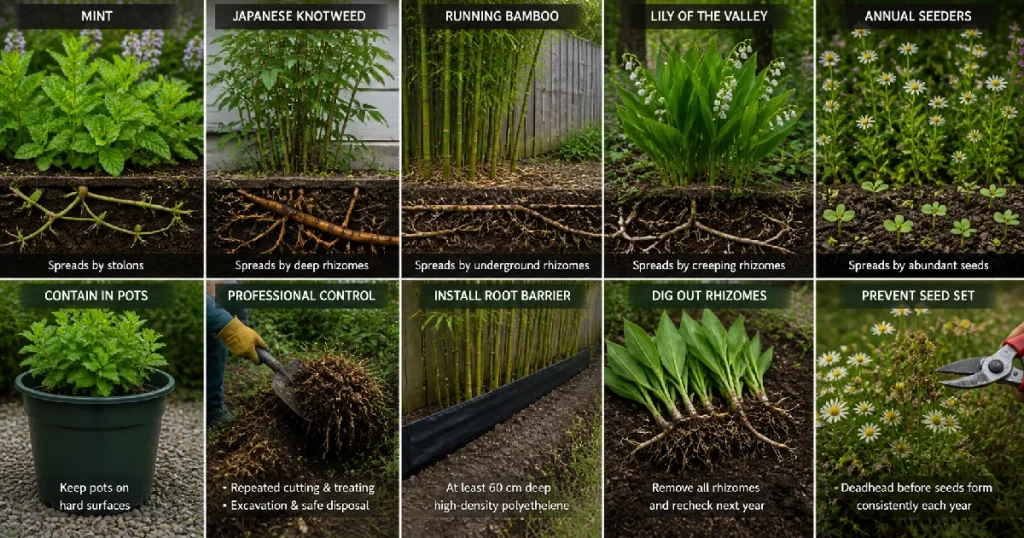
A property owner can make a costly mistake by treating Japanese knotweed as a garden nuisance instead of a structural threat. The rhizomes spread laterally and grow deep, sometimes several meters, surprising those who have never seen it before. Rhizomes smaller than a fingernail can regrow the plant. There have been reports of it damaging building foundations, cracking concrete, and obstructing drainage systems. It is illegal in the UK to allow an infestation to spread onto a neighboring property, so mortgage lenders have rejected applications for homes with infestations on or near the property. The casual hand-pulling methods that work on regular garden weeds don’t work very well on knotweed; instead, it requires either professional excavation and disposal or repeated cutting and chemical treatment applied directly to the cut stems.
A similar territory is occupied by running bamboo, the Phyllostachys varieties that are enthusiastically sold in garden centers as fast-growing privacy screens. In open soil, it is nearly impossible to contain, lovely, and actually useful as a windbreak or visual screen. The rhizomes of running bamboo spread horizontally below the surface at a rate that can cover several feet in a single growing season, sending up new culms far from the original planting. Bamboo rhizomes have sometimes been found under fences in gardens where the rhizomes were planted against a fence for a fence to prevent them. Before burying the bamboo, install a continuous high-density polyethylene root barrier that is at least sixty centimeters deep around the entire planting. Doing it after the fact requires excavating an established root system that has already thoroughly investigated the surrounding soil.
Lily of the Valley exhibits a milder version of this problem. This plant is less aggressive and has shallower rhizomes than knotweed or bamboo, but it is toxic enough to deter human disturbance and forms dense mats that push out anything growing near it. It will grow from a tiny clump to a solid ground cover covering several square meters if left unchecked for a few seasons. When that happens, all of the connecting rhizomes must be excavated along with the mat. If any fragments were missed, the process must be repeated the following year.
| Category | Details |
| Subject | Aggressively Spreading Garden Plants — Identification & Containment |
| Spreading Methods | Rhizomes (underground stems), Stolons (surface runners), Prolific seeding |
| Most Notorious Rhizome Spreaders | Japanese Knotweed, Running Bamboo, Lily of the Valley, Comfrey, Yarrow |
| Most Notorious Stolon Spreaders | All Mint species, Raspberries/Blackberries, Deadnettles, Chinese Lantern |
| Most Prolific Seeders | Purple Loosestrife (2–3 million seeds per plant), Borage, Fennel, Echinacea |
| Most Destructive Species | Japanese Knotweed — rhizomes penetrate pavement and building foundations |
| Best Containment Method | Buried pot with landscape fabric lining; rim above soil level |
| Root Barrier Depth Required | Minimum 24–30 inches for rhizomatous plants |
| What NOT to Do | Till or break up rhizomes — fragments regenerate into new plants |
| Removal Timeline | Japanese Knotweed: up to 4 years of consistent removal to fully eliminate |
| Herbicide Option | Systemic glyphosate painted directly onto leaves; multiple applications over years |
When gardeners learn all of this after the fact, it’s hard not to feel sorry for them. Plants such as mint have a wonderful scent, bamboo has an architectural appearance, and lily of the valley flowers are among the most delicate of spring flowers. Plants are planted with good intentions, sold without sufficient notice, and allowed to spread before they are discovered. Anyone considering using a known spreader in a garden should choose containment before planting, rather than after. Planting rhizomatous plants in the ground requires a buried pot lined with landscape fabric, with the rim resting slightly above the soil’s surface. On hard surfaces, stoloniferous plants thrive in above-ground containers. Deadheading before seed set is effective as long as it is done consistently each year for prolific seeders. All of these measures are straightforward. Before the plant can do its best work, they must be completed.
As a Senior Editor at Mini Greenhouse Kits, Hannah Kinsley is a passionate supporter of small-space gardening and urban gardening. Hannah, who is currently majoring in Environmental Policy through the University of Michigan’s Environmental Studies program, infuses her writing with a solid academic foundation and a sincere enthusiasm for the environment. You can find her playing soccer or exploring the city’s green areas with friends when she’s not researching the newest trends in city gardening or creating content for minigreenhousekits.com.