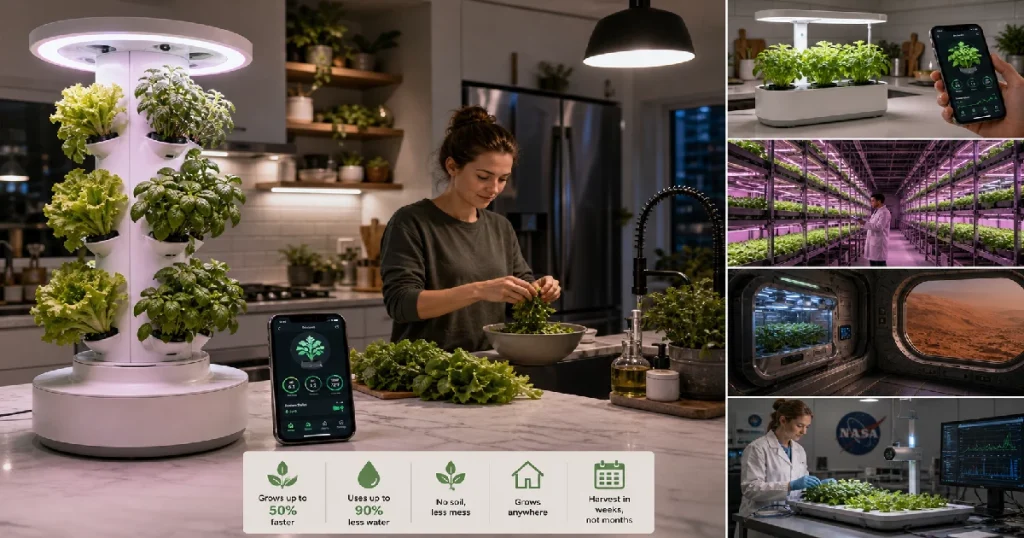
A sleek white tower in someone’s kitchen, with its LED halo illuminating neat rows of butter lettuce and basil in a faint blue-pink glow, can cause a certain kind of cognitive dissonance if you realize it’s a functioning farm. There is no dirt. There is no outdoor area. There is no connection between the weather, the seasons, or the caprices of a supply chain that spans three states and the delivery of wilting herbs in plastic clamshell packaging. The owner was initially dubious, bought a unit on a whim, and six weeks later was harvesting salad greens that tasted nothing like their grocery store counterparts. This tale is currently playing out in suburban kitchens, townhouses, and apartments across the country.
In hydroponics, plants are grown in nutrient-rich water instead of soil. Since at least the 1980s, commercial operations have operated controlled-environment agriculture at scale, which has long been a feature of research institutions and large greenhouse operations. There has been a change in the consumer side of things. Due to the pandemic-era interest in food security and the growing apprehension about industrial agriculture, the systems have become more affordable, smaller, and genuinely easier to use, and many people have been encouraged to try them. Market reaction was appropriate. Businesses like AeroGarden and Lettuce Grow have been offering floor-standing and countertop units to homeowners for years, and new competitors keep emerging. As a consumer good, the category hardly existed ten years ago.
Its numbers are compelling enough to justify interest. Watching lettuce grow from seed to harvestable in about three weeks will show that hydroponic crops can grow up to 50% faster than those grown in soil. As hydroponic systems continuously recirculate their water supply and lose very little to evaporation or runoff, their water consumption is about 10% lower than conventional farming. Plant roots grow directly in a nutrient solution, so they don’t need to spend energy searching for nutrients in the soil. Everything is provided to them. The result is faster, denser growth in a small space.
Indoor gardens are becoming data-driven thanks to automation and artificial intelligence
Compared to previous waves of hydroponic enthusiasm, the advent of machine learning and sensor technology at an affordable price truly sets the current era apart. In what the industry calls “AI hydroponics,” environmental sensors that measure temperature, humidity, pH, electrical conductivity, CO2 levels, and light intensity are combined with algorithms that continuously analyze the data and make real-time adjustments, such as nutrient dosing, irrigation timing, and lighting schedules, without human intervention. Compared to manual operation, commercial growers who use these systems report yield increases of 30 to 40 percent. Plants thrive in conditions that are perfectly stable, no matter how careful humans are. Artificial intelligence doesn’t.
The more immediate version of this for home growers is app-based monitoring, which lets you check the pH and temperature of your system from your phone while you’re at work, receive alerts if anything deviates from safe limits, and modify a lighting schedule without touching the unit. If you have previously killed houseplants due to inconsistent care, it can mean the difference between a functional system and an abandoned experiment collecting dust in a corner. With the technology, learning curves are becoming much less steep, which is important for adoption. It is still unclear whether fully AI-managed home gardens will become a popular product in the future, despite the trajectory appearing to move in that direction.
Hydroponics on Mars: from deserted shopping centers
This story unfolds at two very different scales at the same time, which may be the most unexpected aspect. With the use of hydroponic growing trays stacked floor to ceiling under artificial lighting, shuttered big-box stores, vacant mall floors, and dormant warehouse districts in urban areas are becoming vertical farms that produce leafy greens and herbs for local markets year round, regardless of the weather. Detroit has seen several of these businesses flourish, with Planted Detroit being one of the most prominent examples of what hydroponic urban farming can look like when scaled carefully, rather than just ambitiously. It’s not always easy to understand economics. Investing in commercial vertical farms requires substantial upfront investment due to the high energy costs of large-scale indoor lighting. Well-funded startups that moved too quickly have been humbled by this reality.
Likewise, NASA is testing hydroponic systems as part of the Artemis program’s preparations for long-term lunar and Martian missions. It is now a real-world engineering problem, rather than simply a thought experiment or a narrative convenience taken from science fiction, to grow tomatoes and broccoli inside a space station. Considering its small footprint, controlled inputs, and independence from planetary soil conditions, hydroponics is the obvious choice for any crewed mission to Mars that lasts for years and needs food production that doesn’t rely on resupply from Earth. Each addressing a different aspect of the same issue, the same fundamental technology appears in a NASA research facility and a Brooklyn apartment kitchen.
| Method type | Soil-free cultivation using nutrient-rich water, LED lighting, and automated climate control |
| Water savings | Up to 90% less water than conventional soil farming |
| Growth speed | Crops grow up to 50% faster than soil-based growing |
| AI-assisted yield increase | 30–40% higher yields reported in automated commercial systems |
| Key monitored variables | pH, EC/TDS, water temp, air humidity, CO₂, light intensity, plant growth via camera |
| Applications | Home kitchens, apartments, vertical urban farms, repurposed malls, NASA space missions |
| Space program involvement | NASA testing hydroponic systems for Artemis Moon and Mars missions |
| Key challenge | High upfront capital and ongoing energy costs vs. traditional farming |
It’s difficult not to find some of this truly exciting, despite the hype surrounding food technology. Because of the expenses associated with home hydroponics, such as electricity bills, nutrient solutions that must be replenished, and the initial cost of a good system, most people still use it as a supplement to grocery shopping rather than a replacement. It is cost-effective and fulfilling to grow your own salad greens and herbs on a small scale. Growing your entire diet in an apartment is still unfeasible for nearly everyone. It appears, however, that the direction of travel is clear. The systems are becoming more intelligent, the prices are dropping, and more people are willing to try them. The novelty value of the farm in the living room has worn off. Things are starting to look normal again.
As a Senior Editor at Mini Greenhouse Kits, Hannah Kinsley is a passionate supporter of small-space gardening and urban gardening. Hannah, who is currently majoring in Environmental Policy through the University of Michigan’s Environmental Studies program, infuses her writing with a solid academic foundation and a sincere enthusiasm for the environment. You can find her playing soccer or exploring the city’s green areas with friends when she’s not researching the newest trends in city gardening or creating content for minigreenhousekits.com.