
In early March, you immediately notice a well-kept greenhouse. There is no chaos despite the fact that every surface is occupied. At waist height, seed trays receive the best light from the roof. Propagators hum on solid benching. A smaller pot is arranged on a higher shelf, where the air is warmer and germination occurs more quickly. This is a thoughtful arrangement that transforms what could otherwise be a disorganized glass box into something that actually works. That arrangement has a name. Stages are an aspect of greenhouse growing that novices consistently underestimate.
In greenhouse staging, benches, shelving, and workspace structures are positioned inside a greenhouse to arrange plants at different heights. Plants are placed closer to the overhead light source with standard staging, which is comfortable to work at without bending. Around waist height, it is located between 760 and 910 mm from the floor. The shelves positioned near the eaves and the upper portions of tiered staging are two to three degrees warmer than the floor. This difference is significant, even though it appears small on a thermometer, for germinating seeds, which react to even minute temperature changes in their first few weeks of life. When every degree counts in January and February, seasoned farmers place seed trays at height to take advantage of the warmth.
Material questions arise early in the staging process and are more important than they seem. Aluminum is the most practical option because it is lightweight, rust-resistant, and easy to clean after a season of watering and composting. There is no doubt that timber staging looks better, and the permanence of a wooden bench in a well-maintained greenhouse cannot be matched by aluminum. However, wood requires maintenance, rots easily in damp greenhouse conditions, and harbors woodlice and slugs in its joints and edges. There are also polypropylene options, which are lightweight and durable but less aesthetically pleasing. It usually boils down to how much an individual values aesthetics versus how much time they are willing to devote to maintenance.
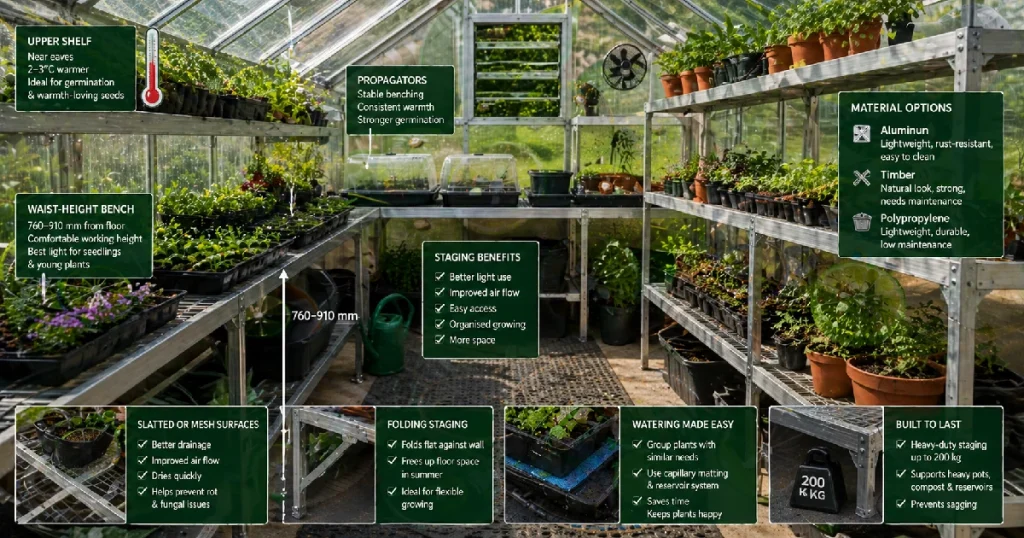
Greenhouse staging ideas for compact and active growing environments
A six-by-eight-foot greenhouse is the most common size in the UK. With careful layout planning, it can support staging along three sides, and is the right size for most gardens. The most common mistake first-time buyers make is buying staging before taking accurate measurements. A staging unit that appeared correct on a website may arrive with the door opening in the exact wrong place after construction. Nominal greenhouse dimensions and actual internal dimensions are rarely the same. In order to design a layout that truly works, you need to measure from the side wall to the door frame, from the front to back along the staging run, and from the floor to the eaves.
In smaller greenhouses, folding staging is perhaps the most underappreciated option. It unhooks and folds flat against the wall in summer when tall crops like tomatoes or cucumbers require floor space. In the growing season, it securely holds trays and pots to the greenhouse frame. A greenhouse that serves both as a propagation area in the spring and as a fruiting environment in the summer really needs that flexibility. It is common for gardeners to resolve the conflict caused by immovable fixed staging by removing entire sections in the middle of the season, which negates the point of using them in the first place.
| Category | Details |
| Topic | Greenhouse Staging |
| Definition | Waist-height shelving and benching systems for greenhouse growing |
| Standard Height | 760mm – 910mm (approx. 30–36 inches) |
| Common Materials | Aluminium, timber, polypropylene/plastic |
| Key Feature | Slatted or mesh surfaces for drainage and air circulation |
| Weight Capacity | Up to 200kg for heavy-duty units |
| Types Available | Freestanding, folding, wall-mounted, integral, multi-tiered |
| Best Layout | U-shaped or side-staged for small 6x8ft greenhouses |
| Temperature Benefit | Upper shelves run 2–3°C warmer — ideal for seed germination |
| Popular Suppliers | Two Wests & Elliott, Harrod Horticultural, B&Q, GardenSite |
| Reference Website | www.twowests.co.uk |
How to Select the Best Greenhouse Staging and Ensure Year-Round Success
Slatted or mesh staging surfaces are often overlooked by buyers. Slugs prefer damp, dark conditions in greenhouses because solid surfaces retain moisture, which promotes fungal growth. With slatted wood or mesh aluminum, air can flow beneath pots and trays, water can drain freely, and the entire surface can dry between waterings. It seems insignificant when a tray of seedlings collapses into rot on a solid surface that hasn’t been properly dried out.
When plants are staged according to their size, growth stage, or watering needs, staging goes beyond shelving. By grouping plants with similar water requirements on the same bench section, it is possible to set up capillary matting and a basic reservoir system that water automatically without daily attention. It takes an afternoon to set up, but it eliminates one of the most time-consuming daily tasks in a busy greenhouse. A well-zoned staging system operating in February gives the impression that the greenhouse is handling most of the work on its own.
Heavy-duty staging up to 200 kg is crucial when storing big pots, compost bags, or water reservoirs. Underestimating load capacity is a slow-motion problem; by midsummer, when the pots have grown and filled with root mass, staging that can support a spring tray load quietly begins to sag. People rarely regret purchasing a little bit more capacity than they initially thought was necessary.
Alyssa Bennet is a Senior Editor at Mini Greenhouse Kits and a passionate advocate for urban gardening and small-space growing. Currently pursuing her major in Arts at the University of California, Alyssa brings a distinctly creative eye to the world of city gardening – blending artistic sensibility with a genuine love for green living. She writes regularly at minigreenhousekits.com, and when she’s not crafting her next gardening piece, you’ll find her with a paintbrush in hand, watching sports, or exploring the city with friends.