Picking a tomato you grew yourself gives you a sense of satisfaction. It is irrelevant that it originated from a five-gallon bucket sandwiched between two patio chairs. Tomatoes are unaware of that. After watching it climb toward whatever sun it can find all summer, neither do you.
This is not because it is fashionable, but rather because it addresses a very real issue. One of the most useful growing techniques available to home gardeners has been container gardening. Land is a scarce resource for most people. Many people nowadays grow food in pots, whether they live in apartments, rent townhouses, or have shaded backyards in the suburbs.
Despite the fact that it is easy to make mistakes at first, the principles are not complicated. The importance of drainage cannot be overstated. Planters without bottom holes are slow-drowning chambers for roots. Most novices discover this the hard way, watching as a once-promising pepper plant turns yellow and crumbles due to soggy soil. In smaller pots, there are three to six holes, whereas in larger pots, there are six to eight holes. It sounds excessive until it isn’t.
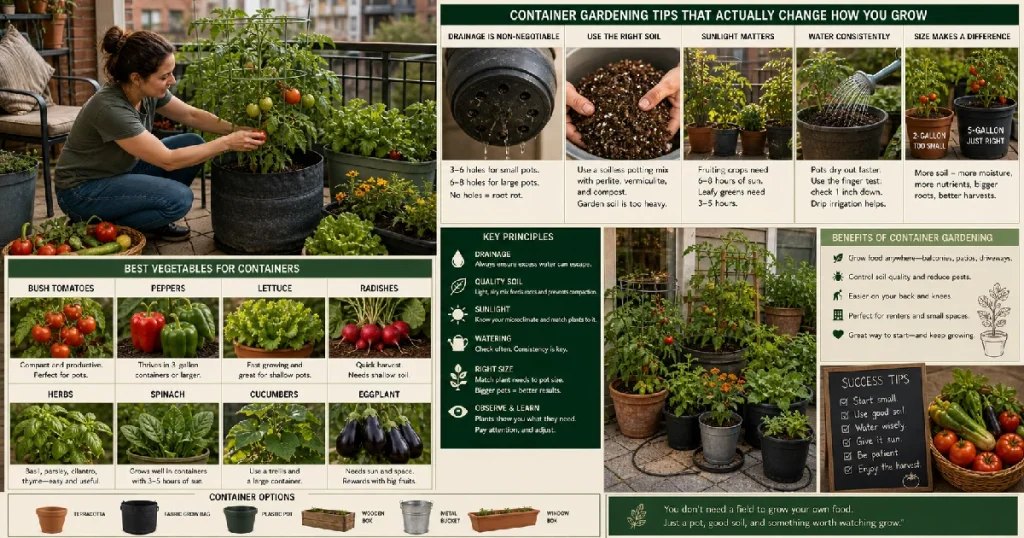
Container Gardening Tips That Actually Change How You Grow
It is more important than most people realize to choose the right soil for your plants. The soil dug from an outdoor bed is too dense and heavy, and it contains diseases that thrive in small spaces. A good soilless potting mix provides oxygen and drainage to the roots. Usually, it is composed of peat or coconut coir, perlite, and vermiculite. By adding compost to the soil, you can give the plant a great start. A minor choice can have a significant impact on the season as a whole.
Sunlight is another factor that surprises people. It typically takes six to eight days for fruiting crops, such as tomatoes, peppers, cucumbers, and eggplant, to mature. When it’s less than that, you’ll get foliage but little fruit. In three to five hours, spinach and lettuce will still be edible. Container gardening is more dependent on small microclimates than any other growing method, such as a building’s south-facing wall, a balcony’s sun-trap corner, or a driveway’s edge that retains heat into the evening.
Watering is the most important aspect of container gardening. A pot can dry out much faster than a garden bed on a hot July afternoon. The finger test, which involves pressing an inch into the ground to check for moisture, becomes second nature after a few weeks. Gardeners use drip irrigation when a tray of wilted seedlings results from missing a morning. That’s not a failure. It’s just a way of coping with a hectic schedule.
The Best Vegetables for Container Gardening Beginners
Size is the most overlooked factor when selecting containers. A tomato plant in a two-gallon pot should thrive. By August, it will appear exhausted and only produce a small portion of what a five-gallon container with adequate root space could produce. In general, larger pots hold more soil, moisture, and nutrients. When there are structural limitations on balconies and upper floors, weight is a trade-off.
There are some crops that are naturally suited to containers. Unlike indeterminate tomatoes, bush tomatoes stop growing at a certain height, rather than sprawling endlessly. Pepper varieties can be planted in a three-gallon pot without overflowing. Radishes, lettuce, and herbs grow quickly, are easy to harvest, and require a shallow container or window box.
| Category | Details |
| Topic | Container Gardening |
| Method | Growing plants in pots, bags, or boxes instead of ground soil |
| Best For | Balconies, patios, rooftops, small yards |
| Common Crops | Tomatoes, peppers, lettuce, herbs, cucumbers |
| Minimum Pot Size | 5 gallons for large vegetables |
| Sunlight Needed | 6–8 hours for fruiting plants, 3–5 for leafy greens |
| Soil Type | Soilless potting mix — never garden soil |
| Skill Level | Beginner to advanced |
| Key Benefit | Space-saving, weed-free, full growing control |
| Reference Website | www.almanac.com |
In container gardening, the perceptive seem to be rewarded more than the technically proficient. As you pass a row of pots in the morning, you’ll notice which ones appear stressed and which ones have pushed out new growth. The kind of attention that develops instinct faster than any guide is this kind of attention. Plants always communicate with one another. Understanding what they’re saying takes only a season or two.
There is no substitute for a proper kitchen garden when it comes to container gardening. Most people, however, cannot afford to have a kitchen garden. There is a front door, a balcony, and a concrete strip next to the back door. It is neither an apology nor a compromise for them to garden in containers. You only need a pot, healthy soil, and something worth watching.
Olivia Murphy is a Senior Editor at Mini Greenhouse Kits and a fervent supporter of small-space and urban gardening. Alyssa, who is currently majoring in both literature and biology at Michigan State University, infuses her writing about city gardening and small-space growing with a unique blend of scientific curiosity and storytelling instinct. Her love of literature influences how she tells the stories behind the plants, and her background in biology gives her content a grounded, research-informed edge. When she’s not working on her next gardening piece, you can find her curled up with a good magazine or watching a movie that she’s been meaning to watch for weeks. She writes with passion at minigreenhousekits.com.